
Canadian Citizenship Requirements 2026: Complete Checklist
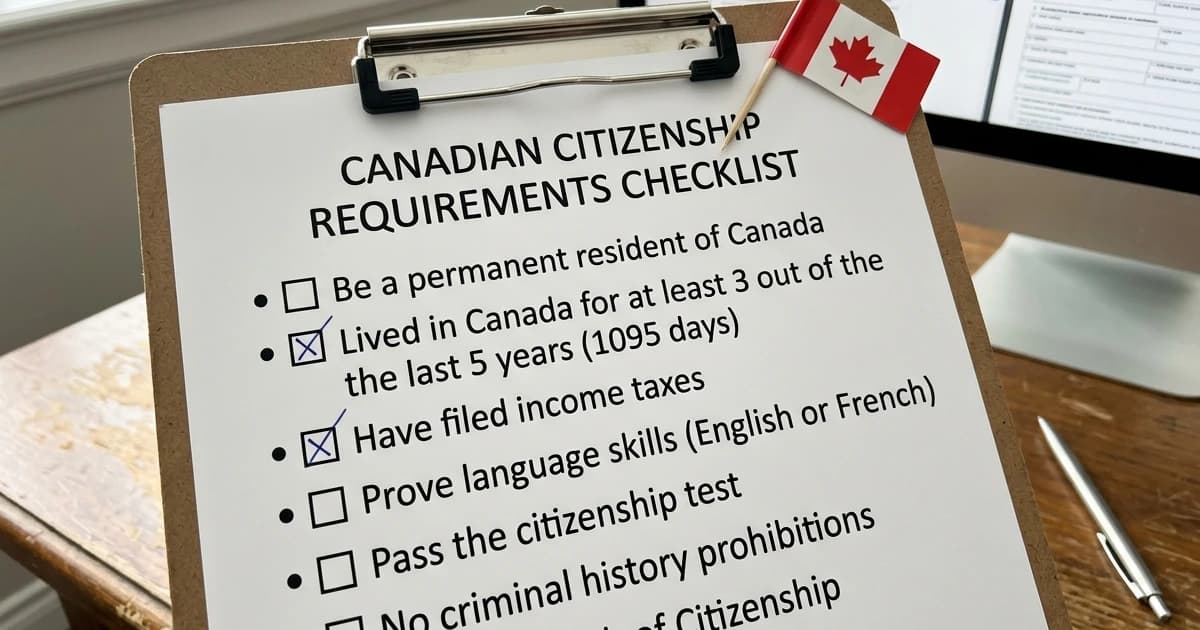
Becoming a Canadian citizen is one of the most meaningful steps in your immigration journey. But before you fill out any forms, you need to make sure you actually qualify.
The requirements are straightforward — once you understand them. This guide walks you through every eligibility requirement for Canadian citizenship in 2026, with practical examples and links to official IRCC sources.
If you meet all of these, you're ready to apply.
The Complete Eligibility Checklist
Here's a quick overview of what you need. We'll break down each one in detail below.
| # | Requirement | Who It Applies To |
|---|---|---|
| 1 | Permanent resident (PR) status | Everyone |
| 2 | Physical presence — 1,095 days in the last 5 years | Everyone |
| 3 | Income tax filing — 3 out of 5 years | Everyone (if required under the Income Tax Act) |
| 4 | Language skills — CLB/NCLC Level 4 in English or French | Adults aged 18-54 |
| 5 | Knowledge of Canada — pass the citizenship test | Adults aged 18-54 |
| 6 | No prohibitions — no criminal or security prohibitions | Everyone |
| 7 | Application fees | Everyone |
Source: IRCC — Who can apply for citizenship
1. Permanent Resident (PR) Status
This is the first and most basic requirement: you must be a permanent resident of Canada.
You cannot apply for citizenship if you are on a work permit, study permit, visitor visa, or any other temporary status. You need your PR card (or Confirmation of Permanent Residence) to prove this.
Key points:
- Your PR status must be valid — it cannot have been revoked
- If you became a PR through fraud or misrepresentation, you are not eligible
- Temporary residents cannot apply, even if they have lived in Canada for many years
If you're not yet a PR, citizenship is not the next step — permanent residency is. Visit IRCC's immigration page to explore your options.
2. Physical Presence: 1,095 Days in 5 Years
This is the requirement that trips up the most people. You must have been physically present in Canada for at least 1,095 days (3 years) during the 5 years immediately before you sign your application.
Source: IRCC — Calculate your physical presence
How the Calculation Works
The "5-year window" is the 5 years (1,826 days) immediately before the date you sign your citizenship application. Within that window, you need at least 1,095 days physically in Canada.
The math is simple: Total days in Canada during the 5-year window must be at least 1,095.
Calculation Example
Let's say you sign your application on June 1, 2026. Your 5-year window is June 1, 2021 to June 1, 2026.
| Period | Location | Days |
|---|---|---|
| June 2021 - Dec 2021 | In Canada | 214 |
| Jan 2022 - Mar 2022 | Trip to home country | 90 |
| Apr 2022 - Dec 2023 | In Canada | 640 |
| Jan 2024 - Feb 2024 | Vacation abroad | 59 |
| Mar 2024 - June 2026 | In Canada | 823 |
Days in Canada: 214 + 640 + 823 = 1,677 days
This person exceeds the 1,095-day minimum and would meet the requirement.
What Counts (and What Doesn't)
- Counts: Every day you are physically in Canada, including days as a temporary resident or protected person before becoming a PR (at half value — each day counts as half a day, up to 365 days maximum credit)
- Does NOT count: Days spent serving a sentence in prison, on parole, or on probation
- Does NOT count: Days spent outside Canada for any reason (vacations, work trips, family visits abroad)
Use the IRCC Physical Presence Calculator
IRCC provides a free physical presence calculator to help you count your days. Use it before applying.
3. Income Tax Filing: 3 Out of 5 Years
You must have filed your Canadian income taxes for at least 3 years during the 5-year period before your application date — if you were required to file under the Income Tax Act.
Source: IRCC — Eligibility requirements
What this means in practice:
- If you've been a PR for 4 years and worked in all of them, you should have filed taxes for all 4 years (you only need 3)
- If you weren't required to file (for example, you had no income in a given year), that year doesn't count against you
- CRA records are used to verify this — make sure your taxes are filed and up to date before applying
Common mistake: People forget to file taxes for a year when they had low or no income. Even if you owe nothing, file anyway to keep your record clean for your citizenship application.
4. Language Requirement: CLB/NCLC Level 4
If you are between 18 and 54 years old on the day you sign your application, you must prove you can communicate in English or French at Canadian Language Benchmarks (CLB) Level 4 or higher (or NCLC Level 4 for French).
Source: IRCC — Language proof for citizenship
What CLB Level 4 Means
CLB 4 is a basic level of communication. You need to be able to:
- Take part in short, everyday conversations about common topics
- Understand simple instructions, questions, and directions
- Use basic grammar, including simple structures and tenses
- Know enough common words and phrases to answer questions and express yourself
You only need to demonstrate speaking and listening skills — reading and writing are not assessed for citizenship.
How to Prove Your Language Level
You can prove your language skills with:
- A third-party language test — CELPIP-General (English), IELTS General Training (English), or TEF Canada / TCF Canada (French)
- Evidence of completing secondary or post-secondary education in English or French (in Canada or abroad)
- Government-funded language training — If you completed a CLB 4+ language program in Canada
Check the full list of accepted proof on the IRCC website.
How many days must you be physically present in Canada to be eligible for citizenship?
5. Knowledge of Canada: The Citizenship Test
If you are between 18 and 54 years old on the day you sign your application, you must pass the Canadian citizenship test.
The test covers:
- The rights and responsibilities of Canadian citizens
- Canada's history, geography, economy, government, laws, and symbols
All questions are based on the official study guide: Discover Canada: The Rights and Responsibilities of Citizenship.
Test Format (2026)
| Detail | Current Rule |
|---|---|
| Questions | 20 multiple choice |
| Passing score | 15/20 (75%) |
| Time limit | 45 minutes |
| Format | Online, self-administered |
| Attempts | 3 attempts within a 30-day window |
| Language | English or French |
If you don't pass after 3 attempts, IRCC schedules a hearing with a citizenship officer.
Need help preparing? We've written detailed guides to help you:
- How to Pass the Canadian Citizenship Test — study strategies and tips
- How Long Should You Study for the Citizenship Test? — realistic study timelines
- Canadian Citizenship Test Pass Rate — what the data says about who passes
You can also practice daily with our Daily Concept feature, which covers one testable topic from Discover Canada every day.
6. Age Exemptions: Under 18 and 55+
Not everyone needs to meet the language and knowledge requirements.
Exempt from the language requirement AND the citizenship test:
- Applicants under 18 years old (minors)
- Applicants 55 years old or older on the day they sign the application
Source: IRCC — Who can apply
These applicants still need to meet all other requirements (PR status, physical presence, tax filing, no prohibitions).
If you have a medical condition that prevents you from meeting the language or knowledge requirement, you may be able to request a waiver.
7. Application Fees (2026)
Here's what it costs to apply for Canadian citizenship as of April 2026:
| Fee Type | Adult (18+) | Minor (under 18) |
|---|---|---|
| Processing fee | $530 | $100 |
| Right of citizenship fee | $123 | Not applicable |
| Total | $653 | $100 |
Source: IRCC — Citizenship fees
The right of citizenship fee increased from $119.75 to $123 on March 31, 2026 (IRCC notice). This fee is adjusted annually under the Service Fees Act.
Payment: Fees are paid online when you submit your application. If your application is refused, the processing fee is not refunded, but the right of citizenship fee is.
8. Processing Times (Current Estimates)
As of April 2026, the estimated processing time for a citizenship grant application is approximately 12-13 months from submission to ceremony.
Source: IRCC — Check processing times
Timeline breakdown (approximate):
| Stage | Estimated Time |
|---|---|
| Application submission to acknowledgment of receipt (AOR) | 1-2 months |
| AOR to test invitation | 6-9 months |
| Test to ceremony | 2-4 months |
| Total | ~12-13 months |
Processing times can vary depending on:
- How many applications IRCC receives
- Whether your application is complete
- How quickly you respond to any requests for additional information
- Your location (applicants outside Canada/US may face longer waits)
9. Common Mistakes That Delay or Derail Applications
After helping thousands of people prepare for citizenship, here are the most common mistakes we see:
Miscalculating Physical Presence
This is the number one reason applications get returned. People forget to subtract vacation days, business trips, or family visits abroad. Use the IRCC calculator and keep a travel log with exact dates.
Not Filing Taxes
Even in years with low or no income, file your taxes. The CRA record is what IRCC checks. Missing a year could mean your application is returned.
Submitting an Incomplete Application
Missing signatures, missing photos, missing documents — any of these will get your application sent back, adding months to your timeline.
Waiting Too Long to Get Language Proof
Language test bookings can take weeks, and results take time to arrive. Don't wait until you're ready to apply — book your language test early.
Not Studying Enough for the Citizenship Test
The pass rate is around 86%, which means roughly 1 in 7 people fail on their first attempt. The test covers specific facts from Discover Canada — general knowledge of Canada is not enough.
Applying with Unresolved Legal Issues
Any ongoing criminal charges, outstanding warrants, or immigration violations can lead to a prohibition on your application. Resolve these before applying.
Frequently Asked Questions
Can I apply for citizenship if I'm still waiting for my PR card renewal?
Yes. You need to have PR status, not necessarily a valid PR card. If your PR card has expired but your status is valid, you can still apply for citizenship. Include a copy of your Confirmation of Permanent Residence (COPR) or any PR card (even expired) with your application.
Do days as a temporary resident count toward the 1,095 days?
Yes, partially. Days spent in Canada as a temporary resident or protected person before becoming a PR count at half value — each day counts as half a day, up to a maximum of 365 days credit. Days after you became a PR count as full days.
What happens if I'm outside Canada when my test is scheduled?
IRCC sends the test invitation to the email address on your application. If you miss it because you're traveling, you may be able to reschedule, but it could significantly delay your processing. Make sure you're available and checking your email during the period when you expect to receive your test invitation.
Can I apply for citizenship if I have a criminal record?
It depends. Some criminal convictions result in a prohibition that prevents you from applying. Time served in prison, on parole, or on probation does not count toward your physical presence. If you have a criminal record, consult an immigration lawyer before applying. See IRCC's prohibitions page for details.
Do I need to speak both English AND French?
No. You only need to demonstrate adequate knowledge of one of Canada's official languages — either English or French. You choose which language to be tested in.
How long after getting PR should I wait before applying for citizenship?
There's no specific waiting period tied to your PR date. What matters is whether you've accumulated 1,095 days of physical presence within the 5-year window before your application date. For most people, this means waiting at least 3 years after becoming a PR (assuming you've been in Canada continuously). However, days as a temporary resident before PR count at half value, so you may qualify sooner.
Can my children apply at the same time as me?
Yes. You can include minor children (under 18) in your application if they are also permanent residents and meet the physical presence requirement. Minors don't need to take the language or knowledge test. The fee for a minor is $100 (no right of citizenship fee).
Ready to Start Preparing?
Meeting the requirements is the first step. If you're eligible, the next step is preparing for the citizenship test.
Our study guide breaks down exactly how to prepare, and our Daily Concept emails deliver one testable topic from Discover Canada to your inbox every day — so you learn without cramming.
You've already done the hard part by immigrating to Canada. The citizenship test is the last milestone. With the right preparation, you'll pass it.
Ready for the test? CitizenPrep uses adaptive learning to focus on your weak spots, with 850+ concepts from the Discover Canada guide and mock tests that match the real 2026 format. Start free — no credit card required.