
Canadian Citizenship Test 2026: What Changed (New Rules)

If you're preparing for the Canadian citizenship test in 2026, you've probably heard that the rules have changed. You're not imagining it — Immigration, Refugees and Citizenship Canada (IRCC) made significant updates to the citizenship test process, effective March 2026. (See the official IRCC citizenship test page and changes to citizenship rules for details.)
The good news? Most of the changes actually make the test more accessible and less stressful. You now have more time, more attempts, and a clearer process.
This guide breaks down every change, what it means for you, and how to adjust your preparation.
What Changed in 2026? Quick Summary
Here's a side-by-side comparison of the old rules versus the new 2026 rules:
| Feature | Before 2026 | After March 2026 |
|---|---|---|
| Format | In-person (pre-COVID) / Online (COVID era) | Online self-administered (default) |
| Time limit | 30 minutes | 45 minutes |
| Attempts | 2 attempts | 3 attempts within a 30-day window |
| Questions | 20 multiple choice | 20 multiple choice (unchanged) |
| Passing score | 15/20 (75%) | 15/20 (75%) (unchanged) |
| Study material | Discover Canada | Discover Canada (unchanged) |
| After max failures | Hearing after 2 failed attempts | Hearing after 3 failed attempts |
The core test — 20 questions (multiple choice or true/false) from the Discover Canada guide, with a 75% pass threshold — remains the same. What changed is how you take it and how many chances you get.
Is the 2026 Citizenship Test Online or In Person?
The biggest change: the self-administered online test is now the standard format for all citizenship test applicants.
Before 2026, IRCC used a mix of in-person tests at local offices and online tests during COVID. Now, the online format has been formalized as the default.
What this means for you:
- You'll take the test from your own computer at home
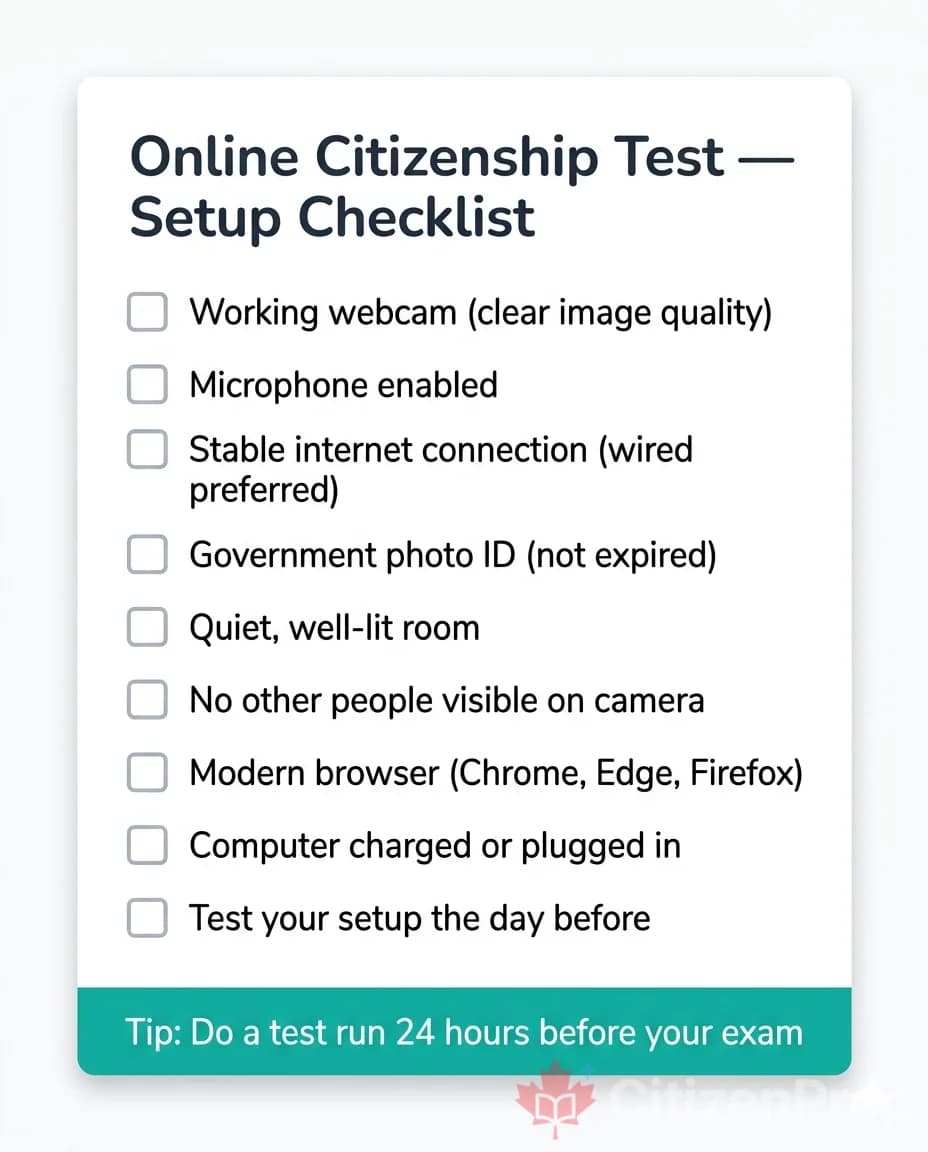
- You need a webcam, microphone, and stable internet connection
- You'll verify your identity by showing government-issued photo ID on camera
- The test is self-proctored (no live examiner watching you)
Alternative formats still available:
- Microsoft Teams session — supervised online if you request accommodations
- In-person test — at an IRCC office, for applicants who cannot take the test online
If you have accessibility needs, you can request accommodations from IRCC.
As of 2026, how many attempts do you get on the Canadian citizenship test?
How Long Is the 2026 Citizenship Test?
This is welcome news for many test takers. The time limit has been increased from 30 minutes to 45 minutes.
With 20 questions, that gives you approximately 2 minutes and 15 seconds per question — plenty of time to read carefully, think through your answer, and review if needed.
Why this matters:
- Less time pressure means fewer mistakes from rushing
- ESL (English as a Second Language) test takers benefit the most — more time to process questions
- You can review your answers before submitting (something many people didn't have time to do before)
How Many Attempts Do You Get on the Citizenship Test?
Previously, you had 2 attempts to pass. If you failed both, you were scheduled for a hearing with a citizenship officer.
Now, you get 3 attempts within a 30-day window — each one uses the same 20-question format, with a fresh random draw from IRCC's question bank.
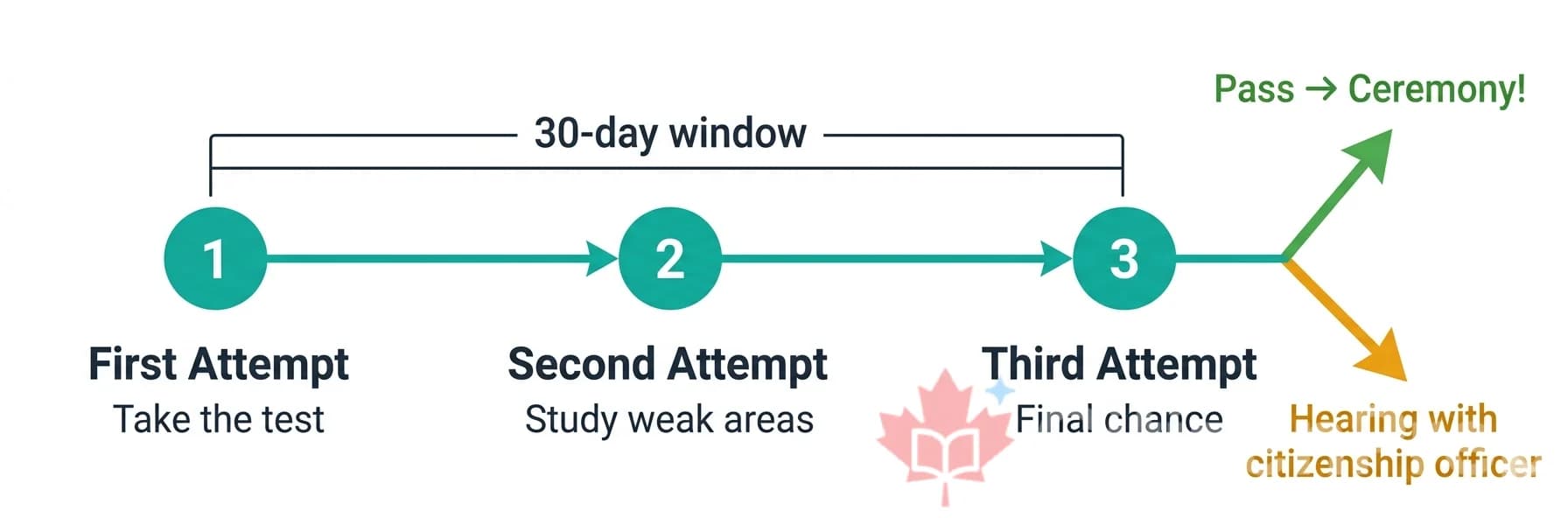
If you don't pass after 3 attempts, IRCC will schedule a hearing with a citizenship officer — an oral interview, typically 30-90 minutes, where the officer assesses your knowledge directly.
For a complete guide to the test format, see our complete guide to passing the citizenship test.
What Topics Are on the 2026 Citizenship Test?
The test still covers all 12 topics from the Discover Canada: The Rights and Responsibilities of Citizenship guide. IRCC has been adding more questions in these areas: Indigenous peoples and history, constitutional history, modern Canada, and provincial/territorial government.
You can practice all of these topics with free practice questions or try today's daily concept to build your knowledge one topic at a time.
How to Prepare for the 2026 Test
The preparation strategy hasn't fundamentally changed — you still need to study the Discover Canada guide. But here's how to make the most of the new rules:
1. Use the Extra Time Wisely
With 45 minutes instead of 30, you can afford to:
- Read each question twice before answering
- Eliminate obviously wrong answers first
- Flag uncertain questions and return to them
- Review all 20 answers before submitting
2. Don't Fear the First Attempt
With 3 attempts available, your first try doesn't need to be perfect. Think of it as:
- Attempt 1: Diagnostic — see what the real test feels like
- Attempt 2: Focused — study what you got wrong
- Attempt 3: Confident — you know the format and your weak spots
That said, thorough preparation gives you the best chance of passing on your first try — the extra attempts are a safety net, not a strategy.
3. Prepare Your Setup Early
Since the test is online by default, run through the full setup checklist at least a day or two before — not minutes before your scheduled time.
What if something goes wrong? If your internet drops or your computer crashes mid-test, contact IRCC immediately. Keep your test invitation email handy — it includes instructions for technical issues. IRCC generally allows you to resume or reschedule if there was a genuine technical problem.
4. Study Smart, Not Just Hard
The Discover Canada guide is 50+ pages of dense material. Our study guide breaks it down chapter by chapter with study tips and time estimates for each section.
Focus on:
- Government structure (most commonly tested)
- Canadian history dates (Confederation, constitutional amendments)
- Rights and responsibilities (the difference matters!)
- Your specific province (premier, lieutenant governor, legislature)
CitizenPrep covers all of these topics with adaptive practice sessions and mock tests that match the real 45-minute, 20-question format — so you're practicing under realistic conditions from day one.
What Hasn't Changed
It's easy to get overwhelmed by the changes. Here's what's exactly the same:
- 20 questions (multiple choice or true/false) — same format
- 75% passing score — still need 15/20
- Discover Canada is still the only official study guide
- Ages 18-54 must take the test (under 18 and 55+ are exempt)
- English or French — you choose which language to take the test in
- Results are immediate — you'll know if you passed right after submitting
- No negative marking — wrong answers don't cost extra points, so always answer every question
Frequently Asked Questions
How many questions are on the 2026 Canadian citizenship test?
The test has 20 questions (multiple choice or true/false), randomly selected from a bank of 300-400 questions maintained by IRCC. This hasn't changed in 2026.
How much time do I have on the citizenship test?
As of March 2026, you have 45 minutes to complete 20 questions. This was increased from the previous 30-minute limit.
How many times can I take the citizenship test?
You now get 3 attempts (increased from 2). If you don't pass after 3 attempts, IRCC schedules a hearing with a citizenship officer.
Is the citizenship test online or in person?
The online self-administered test is now the default format. You take it from home on your own computer. In-person and Microsoft Teams options are available for those who need accommodations.
What happens if I fail the citizenship test 3 times?
After 3 unsuccessful attempts, IRCC will schedule a hearing with a citizenship officer. This is a one-on-one oral interview where the officer asks you questions about Canada to assess your knowledge. It typically lasts 30-90 minutes.
Can I still take the test in French?
Yes. You can choose to take the test in English or French — this hasn't changed. The questions and answer choices will be in your chosen language.
When did the new citizenship test rules take effect?
The updated rules were announced by IRCC and took effect in March 2026.
Do I need a webcam for the online citizenship test?
Yes. You need a working webcam and microphone for identity verification. You'll also need to show your government-issued photo ID on camera before starting.
Preparing for the 2026 test? CitizenPrep uses adaptive learning to focus on your weak spots — 850+ concepts, 1,900+ practice questions, and mock tests that match the current 45-minute format. Start free — no credit card required.