
50 Canadian Citizenship Test Practice Questions (Free)

Looking for practice questions for the Canadian citizenship test? Here are 50 free questions based on the official "Discover Canada" study guide — the same source used for the real test.
The real test has 20 questions (multiple choice or true/false) and you need 15 correct (75%) to pass within a 45-minute time limit. Use these questions to test your knowledge and find your weak areas. For the latest on test format and rules, see our guide to the 2026 citizenship test changes.
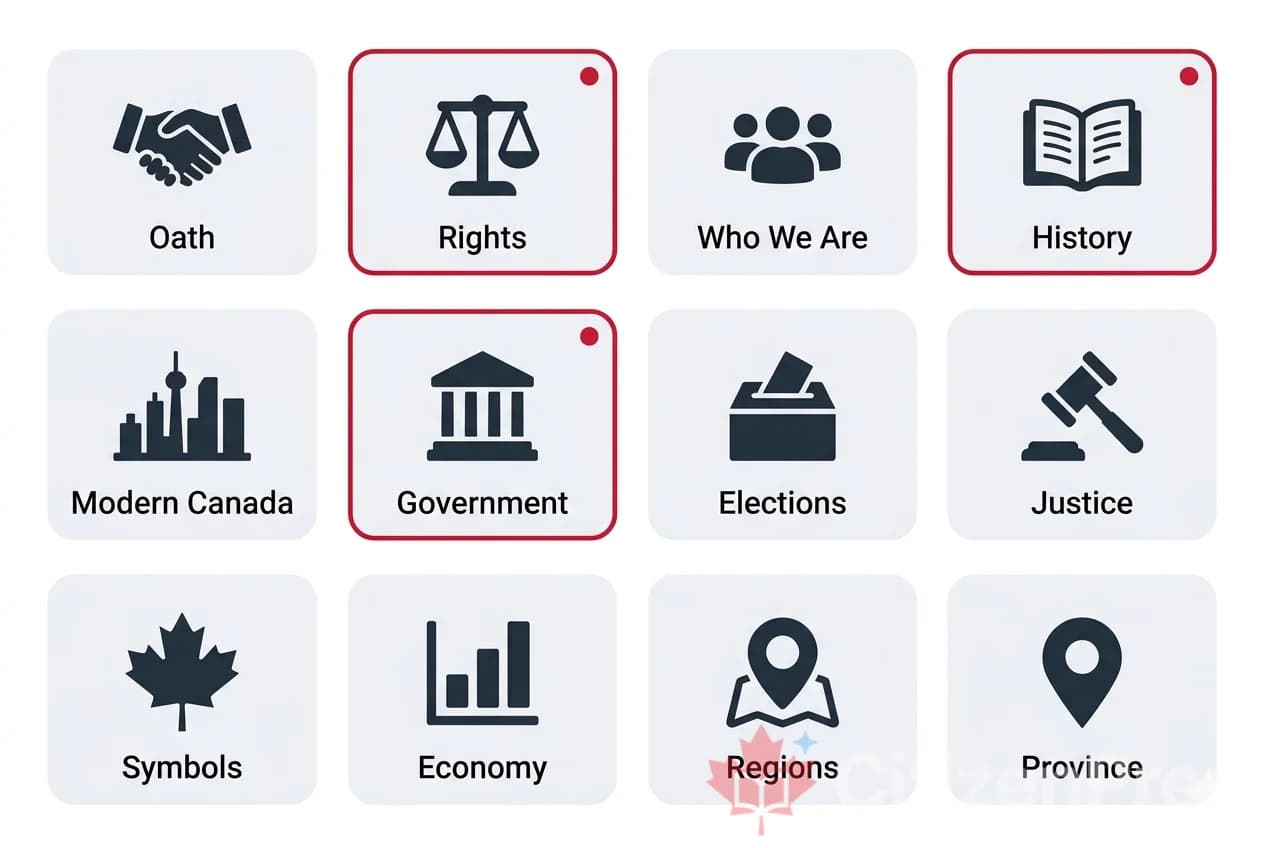
These 50 questions span all 12 chapters of the Discover Canada guide. Use the chapter headings below to track which topics you struggle with.
How to Use These Questions
- Try answering each question before looking at the answer
- Keep track of which ones you get wrong
- Focus your study time on the topics where you struggle
- Come back and try again after studying
- For a structured approach, follow our chapter-by-chapter study guide
The Oath of Citizenship (Chapter 1)
1. What do you promise when you take the Oath of Citizenship?
- A) To pledge loyalty to the Queen of England
- B) To fulfil your duties as a Canadian citizen and obey Canadian laws
- C) To serve in the Canadian military
- D) To live in Canada permanently
Answer: B — The Oath has two parts: swearing allegiance to His Majesty King Charles the Third, King of Canada, and promising to observe Canadian laws and fulfil duties as a citizen.
2. Who do new citizens swear allegiance to in the Oath of Citizenship?
- A) The Prime Minister
- B) The Canadian flag
- C) His Majesty King Charles the Third, King of Canada
- D) The Constitution
Answer: C — The Oath of Citizenship includes swearing allegiance to the Sovereign, currently King Charles III.
Rights and Responsibilities (Chapter 2)
3. What is the Canadian Charter of Rights and Freedoms?
- A) A list of recommended behaviours for citizens
- B) Part of the Constitution that protects fundamental rights
- C) An international agreement signed by Canada
- D) A guide for new immigrants
Answer: B — The Charter is part of the Constitution of Canada and guarantees fundamental freedoms, democratic rights, mobility rights, legal rights, and equality rights.
4. Name one fundamental freedom protected by the Charter.
- A) The right to own property
- B) Freedom of conscience and religion
- C) The right to free healthcare
- D) Freedom from paying taxes
Answer: B — Fundamental freedoms include freedom of conscience and religion, freedom of thought, belief, opinion and expression, freedom of peaceful assembly, and freedom of association.
5. What is a responsibility of Canadian citizenship?
- A) Volunteering in the community
- B) Voting in elections
- C) Learning both English and French
- D) Travelling within Canada
Answer: B — Voting in federal, provincial, and municipal elections is a responsibility of citizenship. Other responsibilities include serving on a jury, obeying the law, and helping others in the community.
6. What does "equality under the law" mean in Canada?
- A) Everyone earns the same salary
- B) Everyone is treated the same regardless of sex, race, or religion
- C) Everyone must speak both official languages
- D) Everyone pays the same amount of tax
Answer: B — Equality rights ensure that federal and provincial governments cannot discriminate based on race, sex, ethnic origin, religion, mental or physical disability, age, or sexual orientation.
What is the highest court in Canada?
Who We Are (Chapter 3)
7. Who are the Aboriginal peoples of Canada?
- A) The French and the British
- B) First Nations, Inuit, and Métis
- C) Immigrants from Asia
- D) People born in Canada
Answer: B — The three groups of Aboriginal (Indigenous) peoples are First Nations, Inuit, and Métis.
8. What are the two official languages of Canada?
- A) English and Mandarin
- B) English and Spanish
- C) English and French
- D) French and Inuktitut
Answer: C — English and French are the two official languages of Canada, and have equal status in federal government institutions.
9. Which province has the largest number of French-speaking Canadians?
- A) Ontario
- B) Manitoba
- C) New Brunswick
- D) Quebec
Answer: D — Quebec is home to the largest population of French-speaking Canadians. Most Quebecers speak French as their first language.
Canada's History (Chapter 4)
10. What year did Canada become a country through Confederation?
- A) 1776
- B) 1812
- C) 1867
- D) 1905
Answer: C — Canada became a country on July 1, 1867, when the British North America Act united Nova Scotia, New Brunswick, and the Province of Canada (Ontario and Quebec) into the Dominion of Canada.
11. Who was the first Prime Minister of Canada?
- A) Sir Wilfrid Laurier
- B) Sir John A. Macdonald
- C) Sir George-Étienne Cartier
- D) Alexander Mackenzie
Answer: B — Sir John A. Macdonald was the first Prime Minister of Canada and a Father of Confederation who led the project to build the Canadian Pacific Railway.
12. Which four provinces first formed Confederation in 1867?
- A) Ontario, Quebec, Manitoba, British Columbia
- B) Ontario, Quebec, Nova Scotia, New Brunswick
- C) Ontario, Quebec, Prince Edward Island, Nova Scotia
- D) Ontario, Quebec, New Brunswick, Manitoba
Answer: B — The original four provinces were Ontario, Quebec, Nova Scotia, and New Brunswick.
13. What was the significance of the Battle of Vimy Ridge?
- A) It was Canada's last battle in World War I
- B) It is celebrated as a defining moment for Canadian national identity
- C) It ended World War II
- D) It was a battle fought in Canada
Answer: B — The Battle of Vimy Ridge in April 1917 is considered a defining moment for Canada. All four divisions of the Canadian Corps fought together for the first time, capturing the ridge that others had failed to take.
14. What does the term "Métis" refer to?
- A) French-speaking Canadians
- B) A distinct people of mixed Indigenous and European ancestry
- C) People from Quebec
- D) First Nations people from the prairies
Answer: B — The Métis are a distinct people of mixed Indigenous and European ancestry, with their own culture, language (Michif), and traditions.
Modern Canada (Chapter 5)
15. What did the Suffrage Movement achieve?
- A) The right for Indigenous peoples to vote
- B) Equal pay for women
- C) The right for women to vote
- D) The abolition of slavery
Answer: C — The Suffrage Movement fought for and won women the right to vote. Women's suffrage was achieved gradually — in federal elections starting in 1918, with Quebec being the last province in 1940.
16. When was the Canadian flag with the red maple leaf first raised?
- A) 1867
- B) 1931
- C) 1965
- D) 1982
Answer: C — The current Canadian flag, featuring the red maple leaf, was raised for the first time on February 15, 1965.
How Canadians Govern Themselves (Chapter 6)
17. What are the three levels of government in Canada?
- A) City, province, territory
- B) Federal, provincial/territorial, and municipal
- C) Parliament, Senate, and Crown
- D) Executive, legislative, and judicial
Answer: B — The three levels of government are federal (national), provincial or territorial, and municipal (local/city).
18. What is the role of the King or Queen in Canada's government?
- A) To make new laws
- B) To lead the military
- C) Canada's Head of State, represented by the Governor General
- D) To run the day-to-day government
Answer: C — The Sovereign (King or Queen) is Canada's Head of State. The Governor General represents the Sovereign in Canada and carries out the Sovereign's duties on a day-to-day basis.
19. What does the Governor General do?
- A) Leads the political party in power
- B) Acts as Head of State on behalf of the Sovereign
- C) Leads the Senate
- D) Appoints the judges
Answer: B — The Governor General is the representative of the Sovereign in Canada, performing duties such as giving Royal Assent to laws passed by Parliament.
20. What is the residence of the Governor General of Canada?
- A) 24 Sussex Drive
- B) Buckingham Palace
- C) The Parliament Buildings
- D) Rideau Hall
Answer: D — Rideau Hall is the official residence of the Governor General of Canada, who represents the Sovereign. The Prime Minister's official residence is 24 Sussex Drive (though recent Prime Ministers have stayed at Rideau Cottage nearby).
21. What are the three parts of Parliament?
- A) Prime Minister, Cabinet, and Senate
- B) House of Commons, Senate, and the Sovereign
- C) Federal government, provincial government, and municipal government
- D) Governor General, Prime Minister, and Opposition Leader
Answer: B — Parliament consists of three parts: the Sovereign (represented by the Governor General), the Senate, and the House of Commons.
22. How are Senators chosen?
- A) Elected by the public
- B) Appointed by the Governor General on the advice of the Prime Minister
- C) Elected by Members of Parliament
- D) Selected by the Supreme Court
Answer: B — Senators are appointed by the Governor General on the advice of the Prime Minister. The Senate reviews and revises legislation and can introduce its own bills.
23. What is the role of the opposition in Parliament?
- A) To support the government's policies
- B) To peacefully oppose the government and propose alternatives
- C) To manage government finances
- D) To appoint judges
Answer: B — Opposition parties peacefully oppose or try to improve government proposals, holding the government accountable and offering alternative policies.
Federal Elections (Chapter 7)
24. Who has the right to vote in federal elections?
- A) All residents of Canada
- B) Canadian citizens who are 18 years or older
- C) Permanent residents who have lived in Canada for 5 years
- D) Anyone with a Canadian social insurance number
Answer: B — Canadian citizens who are 18 years of age or older on election day have the right to vote in federal elections.
25. How is a federal government formed after an election?
- A) The party with the most seats forms the government
- B) The Governor General chooses the ruling party
- C) All parties share power equally
- D) The Senate decides who forms the government
Answer: A — The party that wins the most seats in the House of Commons forms the government. Its leader becomes the Prime Minister.
26. What is a "riding" in Canadian elections?
- A) A political party
- B) An electoral district or constituency
- C) A type of ballot
- D) A campaign event
Answer: B — A riding (also called a constituency or electoral district) is a geographic area represented by a Member of Parliament (MP). Canada is divided into ridings, each electing one MP.
The Justice System (Chapter 8)
27. What is the highest court in Canada?
- A) The Federal Court
- B) The Provincial Superior Court
- C) The Supreme Court of Canada
- D) The Court of Appeal
Answer: C — The Supreme Court of Canada is the highest court in the country. Its decisions are final and binding.
28. What does "habeas corpus" mean?
- A) The right to a lawyer
- B) The right to vote
- C) The right not to be detained unlawfully
- D) The right to free speech
Answer: C — Habeas corpus is the right not to be detained unlawfully. It requires the government to present evidence for detaining a person, ensuring no one is imprisoned without legal justification.
29. Name two Canadian police forces.
- A) The FBI and local police
- B) The RCMP and provincial or municipal police
- C) The military police and border police
- D) The Senate police and city police
Answer: B — The Royal Canadian Mounted Police (RCMP) is the national police force. Most provinces also have provincial police, and cities have municipal police forces.
Canadian Symbols (Chapter 9)
30. What is the national anthem of Canada?
- A) "God Save the King"
- B) "The Maple Leaf Forever"
- C) "O Canada"
- D) "We Stand on Guard"
Answer: C — "O Canada" is the national anthem of Canada. "God Save the King" is the Royal Anthem of Canada.
31. What does the beaver symbolize as a Canadian emblem?
- A) Canada's military strength
- B) The importance of hard work and the fur trade in Canadian history
- C) The beauty of Canadian nature
- D) Canada's relationship with Britain
Answer: B — The beaver was designated as an official emblem of Canada in 1975. It represents the importance of the fur trade in Canadian history and symbolizes hard work and industriousness.
32. What are the official colours of Canada?
- A) Blue and white
- B) Red and white
- C) Red, white, and blue
- D) Green and gold
Answer: B — The official colours of Canada are red and white, as proclaimed by King George V in 1921.
33. What is on the Canadian coat of arms?
- A) A beaver and a maple leaf
- B) Two flags and a crown
- C) Symbols representing England, France, Scotland, and Ireland, with maple leaves
- D) A moose and a pine tree
Answer: C — The Royal Coat of Arms of Canada includes symbols of England (three lions), France (fleur-de-lys), Scotland (lion), and Ireland (harp), along with maple leaves representing Canada.
Canada's Economy (Chapter 10)
34. What are some of Canada's major natural resources?
- A) Diamonds, gold, and silver only
- B) Forestry, mining, oil, gas, and fishing
- C) Only oil and gas
- D) Agriculture only
Answer: B — Canada is rich in natural resources including forestry, mining, oil and gas, fishing, and agriculture. Canada is one of the world's leading exporters of natural resources.
35. What is the name of the trade agreement between Canada, the United States, and Mexico?
- A) NAFTA
- B) CUSMA (Canada-United States-Mexico Agreement)
- C) The Commonwealth Agreement
- D) The Pacific Trade Agreement
Answer: A — According to the Discover Canada guide, the trade agreement between Canada, the United States, and Mexico is called NAFTA (North American Free Trade Agreement). Note: In real life, NAFTA was replaced by CUSMA in 2020, but the Discover Canada guide has not been updated — so NAFTA is the correct answer for the citizenship test.
Canada's Regions (Chapter 11)
36. Name all the provinces of Canada that border the Atlantic Ocean.
- A) Ontario, Quebec, Nova Scotia
- B) Nova Scotia, New Brunswick, Prince Edward Island, Newfoundland and Labrador
- C) British Columbia, Nova Scotia, New Brunswick
- D) Quebec, New Brunswick, Nova Scotia
Answer: B — The four Atlantic provinces are Nova Scotia, New Brunswick, Prince Edward Island, and Newfoundland and Labrador.
37. Which province is the largest in land area?
- A) Ontario
- B) British Columbia
- C) Quebec
- D) Alberta
Answer: C — Quebec is the largest province by land area. Nunavut is the largest territory and the largest overall division.
38. What is the capital city of Canada?
- A) Toronto
- B) Montreal
- C) Ottawa
- D) Vancouver
Answer: C — Ottawa, located in Ontario, is the capital city of Canada and the seat of the federal government.
39. Which province is known as "Canada's breadbasket"?
- A) Alberta
- B) Ontario
- C) Manitoba
- D) Saskatchewan
Answer: D — Saskatchewan is known as "Canada's breadbasket" due to its vast wheat fields and grain production.
40. Name Canada's three territories.
- A) Yukon, Northwest Territories, and Nunavut
- B) Yukon, Manitoba, and Nunavut
- C) Northwest Territories, Nunavut, and Saskatchewan
- D) Yukon, British Columbia, and Nunavut
Answer: A — Canada's three territories are Yukon, Northwest Territories, and Nunavut.
Government and Constitution
41. What is the Constitution of Canada?
- A) A set of guidelines for the Prime Minister
- B) The supreme law of Canada that outlines the system of government and rights of citizens
- C) An agreement between Canada and Britain
- D) A list of federal laws
Answer: B — The Constitution is the supreme law of Canada. It includes the Constitution Act, 1867, the Constitution Act, 1982, and the Canadian Charter of Rights and Freedoms.
42. When did Canada's Constitution come home from Britain?
- A) 1867
- B) 1931
- C) 1982
- D) 2000
Answer: C — In 1982, the Constitution was "patriated" (brought home) from Britain, meaning Canada gained full authority to amend its own Constitution. This also introduced the Charter of Rights and Freedoms.
History Deep Dive
43. What does Confederation refer to?
- A) The joining of provinces and territories to form Canada
- B) Canada's declaration of independence from Britain
- C) The creation of the Canadian military
- D) The union of English and French Canada
Answer: A — Confederation refers to the process of joining British colonies in North America to form the Dominion of Canada, beginning in 1867.
44. Who were the United Empire Loyalists?
- A) French settlers in Quebec
- B) People who moved to Canada from the United States during the American Revolution because they were loyal to the British Crown
- C) British soldiers stationed in Canada
- D) Indigenous allies of the British
Answer: B — The United Empire Loyalists were settlers who fled the American Revolution (1775-1783) to remain loyal to the British Crown, settling primarily in Nova Scotia, New Brunswick, Quebec, and Ontario.
45. What was the Underground Railroad?
- A) A subway system built in the 1800s
- B) A secret network that helped enslaved people escape to freedom in Canada
- C) A mining operation in Ontario
- D) A trade route between Canada and the United States
Answer: B — The Underground Railroad was a network of secret routes and safe houses used to help enslaved people from the United States escape to freedom in Canada before the American Civil War.
Rights and Freedoms
46. What is the meaning of "Remembrance Day"?
- A) A day to celebrate Canada's birthday
- B) A day to honour Canadian veterans and those who died in military service
- C) A day to remember the founding of Canada
- D) A day to celebrate multiculturalism
Answer: B — Remembrance Day (November 11) honours Canadians who have served in the military and those who died in the service of Canada, beginning with World War I.
47. What does the poppy flower symbolize?
- A) Canadian gardens
- B) Remembrance of soldiers who died in war
- C) The beauty of Canada
- D) Canada's floral industry
Answer: B — The poppy is worn on Remembrance Day to honour and remember those who have served and died in Canada's military forces. It was inspired by the poem "In Flanders Fields" by Canadian John McCrae.
Mixed Review
48. Who is Canada's Head of Government?
- A) The Governor General
- B) The Sovereign (King or Queen)
- C) The Prime Minister
- D) The Chief Justice
Answer: C — The Prime Minister is the Head of Government. The Sovereign (represented by the Governor General) is the Head of State. These are different roles.
49. What do Canadians celebrate on July 1?
- A) Victoria Day
- B) Remembrance Day
- C) Canada Day
- D) Thanksgiving
Answer: C — Canada Day is celebrated on July 1, marking the anniversary of Confederation in 1867 when Canada became a self-governing dominion.
50. Why is the Canadian Charter of Rights and Freedoms important?
- A) It sets tax rates for citizens
- B) It guarantees the fundamental rights and freedoms of everyone in Canada
- C) It determines immigration policy
- D) It establishes trade agreements
Answer: B — The Charter guarantees fundamental freedoms, democratic rights, mobility rights, legal rights, equality rights, and language rights. It is part of the Constitution and applies to everyone in Canada.
How Did You Score?
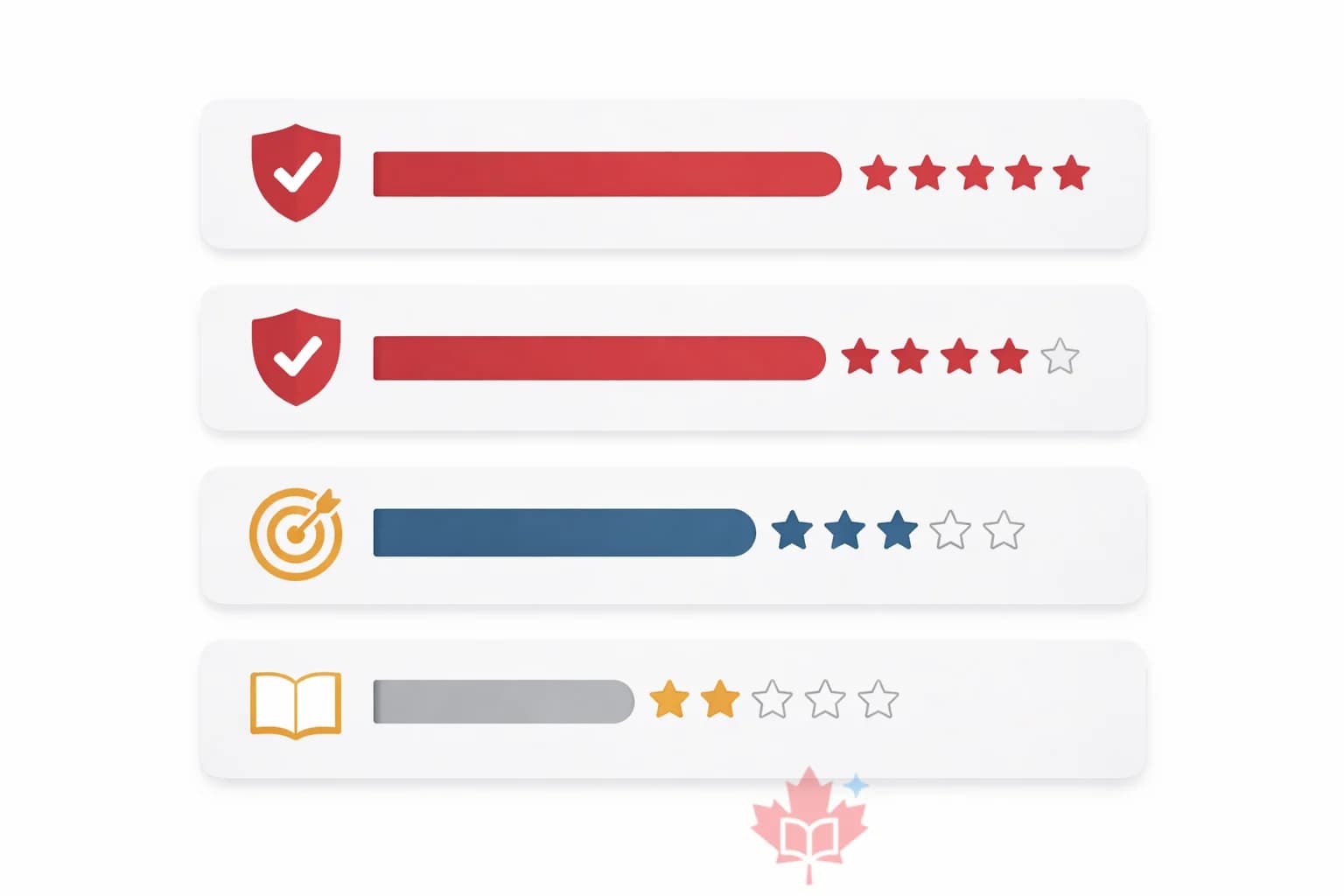
45-50: You're well-prepared. 38-44: Good foundation — review the topics you missed. 30-37: Need more study time — focus on weak chapters. Below 30: Start with the Discover Canada guide and build up.
The real test is 20 questions with a 75% pass threshold (15 correct). Use your score here to identify weak chapters — not as a direct prediction of your result.
Scored below 85%? CitizenPrep automatically identifies which concepts you got wrong and builds every study session around them — so you fix your weak spots instead of re-reading chapters you already know. Start free, no credit card required.
Frequently Asked Questions
Are these the actual questions from the real test?
No. The real test questions are confidential. These practice questions are based on the same source material — the official "Discover Canada" guide — and cover the same topics and concepts you'll be tested on.
How many questions are on the real test?
The real test has 20 questions (multiple choice or true/false). You have 45 minutes and need 15 correct (75%) to pass.
Where can I find more practice questions?
Try our Daily Concept — one free citizenship concept every day with a quiz question, no sign-up needed. Our chapter-by-chapter study guide also has key facts and tips for each section. The Richmond Public Library offers over 100 additional free questions.
What if I want personalized practice?
Unlike static question banks where you see the same questions every time, CitizenPrep uses adaptive learning to focus on your specific weak areas — so you spend time on what you actually need to learn, not what you already know.
Want smarter practice? CitizenPrep has 1,900+ questions from 850+ official concepts, with adaptive learning that targets your weak spots. Start free — no credit card required.