
Citizenship Test vs Interview (Hearing): What's the Difference?
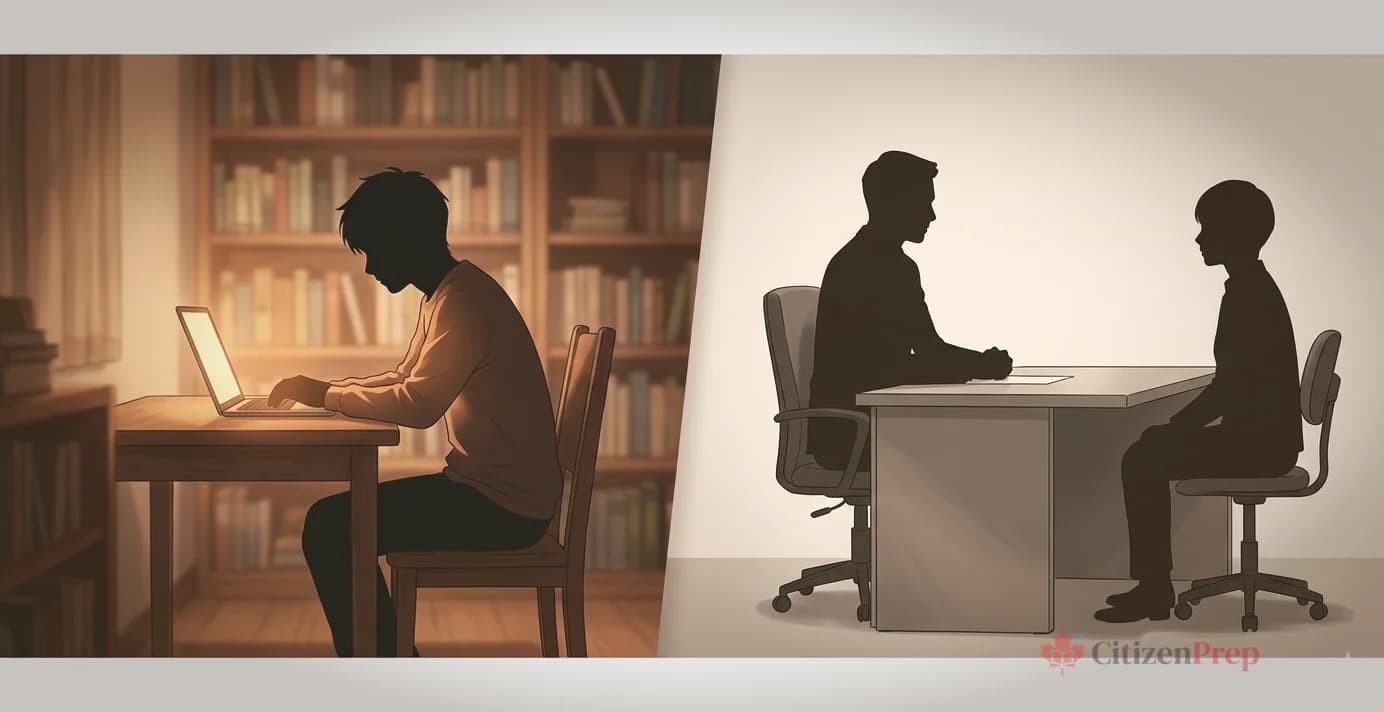
If you're on the path to Canadian citizenship, you've probably heard the terms "citizenship test" and "citizenship hearing" (sometimes called an "interview") and wondered: what's the difference? Will I get one or the other? Can I choose?
The short answer: most applicants take a written test. A hearing only happens if the written test doesn't go as planned, or if IRCC has specific concerns. And if you are heading to a hearing, that's okay — it's designed to be another opportunity, not a dead end.
This guide breaks down exactly how both formats work, who gets each one, and how to prepare no matter which path you're on.
The Written Citizenship Test: What Most People Take
The standard citizenship knowledge assessment is a written, multiple-choice test taken online. This is what the vast majority of applicants experience.
Here's how it works:
- Format: 20 multiple-choice questions drawn from the Discover Canada study guide
- Passing score: 15 out of 20 correct (75%)
- Time limit: 45 minutes (the time limit is generous — most people don't need the full time)
- Language: Available in English or French — your choice
- Location: Online, from anywhere with a computer and webcam (you don't need to be in Canada)
- Proctoring: Your webcam takes random photos during the test for identity verification — there is no live proctor
- Attempts: You get up to 3 attempts within a 30-day test window
The online test is self-administered. IRCC sends you an invitation email with your 30-day window dates, and you choose when to take each attempt within that period. Each attempt generates a new random set of 20 questions from IRCC's question bank.
In-person and Microsoft Teams tests are also available in special circumstances — for example, if you need accommodations, have persistent technical issues, or if an officer determines it's appropriate. For these formats, only one attempt is allowed per scheduled event.
For a full breakdown of the online test experience, see our guide on what to expect on test day.
The Citizenship Hearing: What It Is and How It Works
A citizenship hearing is an oral, one-on-one meeting with a citizenship officer. It's sometimes called an "interview," though IRCC officially uses the term "hearing."
Here's the format:
- Type: Oral examination — the officer asks you questions and you answer verbally
- Questions: The officer may ask up to 9 questions about your knowledge of Canada
- Passing criteria: You must answer at least 6 out of 9 questions sufficiently
- Duration: 30 to 90 minutes
- Location: In-person at an IRCC office or via Microsoft Teams video call
- Language: Conducted in English or French
- Documents: Bring the originals of the documents you submitted with your citizenship application
During the hearing, the citizenship officer may also:
- Assess your language ability — the officer can evaluate whether you meet the required CLB Level 4 in English or French
- Examine other citizenship requirements — as of 2026, officers can check other eligibility requirements during the hearing if they have concerns, even those not originally scheduled for review
- Immediately refuse an application if they find any single requirement is not met
The questions cover the same material as the written test: Canadian history, government structure, rights and responsibilities, geography, symbols, and values — all from the Discover Canada guide. The difference is that you explain your answers in your own words rather than picking from multiple-choice options.
At a citizenship hearing, how many questions must you answer sufficiently to pass?
Side-by-Side Comparison
| Feature | Written Test | Hearing (Interview) |
|---|---|---|
| Format | 20 multiple-choice questions | Oral conversation, up to 9 questions |
| Duration | 45 minutes maximum | 30 to 90 minutes |
| Location | Online (self-administered) | In-person or via Microsoft Teams |
| Passing criteria | 15 out of 20 correct (75%) | At least 6 out of 9 answered sufficiently |
| Attempts | Up to 3 within a 30-day window | One hearing |
| Proctoring | Webcam photos, no live proctor | Face-to-face with a citizenship officer |
| Atmosphere | Timed, self-paced, alone | Conversational, interactive, one-on-one |
| Can ask for clarification? | No | Yes — the officer can rephrase questions |
| Language assessment? | Separate requirement | Officer may assess during hearing |
| Source material | Discover Canada guide | Discover Canada guide |
Who Gets a Written Test vs a Hearing?
The written test is the default. IRCC invites most applicants between ages 18 and 54 to take the online test as the first step.
You'll be invited to a hearing if:
-
You fail the written test 3 times. After using all 3 attempts in your 30-day window without passing, IRCC will schedule a knowledge hearing. This is the most common reason for a hearing.
-
IRCC has concerns about your language ability. If a citizenship officer suspects you don't meet the English or French language requirement (CLB Level 4), they may refer you to a language hearing — or a combined knowledge and language hearing.
-
There are other concerns with your application. In some cases, if IRCC needs to verify other aspects of your application (residency, identity, or other eligibility factors), they may schedule a hearing to address those concerns.
You cannot request a hearing instead of the test. The format is determined by IRCC, not the applicant. Some people assume an oral hearing would be easier, but it's not designed as an alternative — it's a follow-up process for specific situations.
If you have a medical condition or exceptional circumstances that prevent you from taking the written test, you can request a waiver or accommodations from IRCC — but that's different from requesting a hearing.
How to Prepare for the Written Test
The written test is straightforward if you prepare. Here's what works:
Study the Discover Canada guide thoroughly
All 20 questions come from this guide. Read it cover to cover at least twice, then focus on the chapters you find hardest. Our chapter-by-chapter study guide can help you prioritize.
Practice with realistic questions
Don't just read — test yourself. Practice questions help you identify weak areas before the real test. See our practice questions guide or try one concept per day to build knowledge gradually.
Understand, don't just memorize
The questions test comprehension, not rote memory. Understand why Canada has three levels of government, not just that it does. Know what the Charter of Rights and Freedoms protects and why it matters.
Learn your province
Several questions are province-specific. Know your provincial premier, lieutenant governor, capital city, and any unique provincial facts from the Discover Canada guide.
Manage your test anxiety
If nerves are a concern, our guide on managing citizenship test anxiety has evidence-based strategies that actually work.
Use all your attempts wisely
You have 3 attempts in 30 days. If you don't pass the first time, study your weak areas and try again. For a detailed breakdown of what to do after a failed attempt, see what happens if you fail the citizenship test.
How to Prepare for the Hearing
Preparing for a hearing is different from preparing for a multiple-choice test. You need to be able to explain your knowledge, not just recognize the right answer.
Practice speaking your answers out loud
This is the single most important thing you can do. The hearing is oral — you need to articulate your knowledge clearly. Practice explaining Canadian facts to a friend, family member, or even to yourself in the mirror.
For example, instead of just knowing that "the Prime Minister is the Head of Government," practice saying: "The Prime Minister leads the federal government. They are chosen as the leader of the party that wins the most seats in a federal election. The current Prime Minister is [name]."
Focus on understanding, not exact wording
In a hearing, there's no multiple-choice safety net. You need to explain concepts in your own words. The officer isn't looking for textbook-perfect answers — they want to see that you genuinely understand the material.
Study the key topics
The officer's questions will cover the same Discover Canada material, but these areas come up most often:
- Government structure: The three levels of government, the role of the Prime Minister, Parliament, the Monarch
- Rights and responsibilities: What the Charter of Rights and Freedoms guarantees, your responsibilities as a citizen
- Canadian history: Key dates (Confederation in 1867, Constitutional repatriation in 1982), major events
- Symbols: The national anthem, the Canadian flag, the maple leaf, the beaver
- Geography: Provinces and territories, their capitals, your province specifically
Prepare to discuss your own province
Officers often ask about the province you live in. Know your provincial premier, the name of your provincial legislature, and any key facts about your region.
Practice in English or French
The hearing will be conducted in one official language. Make sure you're comfortable discussing these topics in whichever language you'll use. If language is a concern, practice with someone who speaks the language fluently.
Dress respectfully and arrive prepared
This is a formal government proceeding. You don't need a suit, but dress neatly and professionally. Arrive early (or log in early for a video hearing). Bring the originals of all documents you submitted with your application.
Stay calm and take your time
You can ask the officer to repeat or rephrase a question if you don't understand. Take a moment to think before answering. It's better to give a thoughtful answer than to rush.
What Happens If You Fail the Hearing?
If the citizenship officer determines that you don't have sufficient knowledge of Canada during the hearing, your citizenship application will be refused.
This is not the end of the road, but it does mean extra steps:
Option 1: Reapply for citizenship
You can submit a new citizenship application and pay the fees again. Make sure you meet all the eligibility requirements before reapplying. This time, you'd go through the entire process again — including a new written test.
Option 2: Seek judicial review
You have the right to apply for judicial review from the Federal Court of Canada. This is not an appeal — the Federal Court reviews whether the decision was made fairly and in accordance with the law. If the court overturns the decision, your application is typically sent back for a new hearing with a different officer.
Judicial review is a legal process. If you're considering this route, consult an immigration lawyer.
Option 3: Request a waiver (in exceptional cases)
If you have a medical condition or exceptional circumstances that prevent you from meeting the knowledge requirement, you can request a waiver on compassionate grounds. This requires supporting documentation from a medical professional.
Your permanent residency is not affected
Failing the hearing does not affect your permanent resident status. You remain a legal permanent resident of Canada with all the same rights — you can continue living, working, and traveling as before.
Tips for a Successful Hearing
If you're heading to a hearing, here's a checklist:
- Study the Discover Canada guide thoroughly — focus on understanding, not memorization
- Practice explaining facts out loud — to a friend, family member, or yourself
- Review your province's specific details — premier, capital, legislature name
- Know the Oath of Citizenship — what it means and why it matters
- Bring all required documents — originals of everything you submitted
- Dress respectfully — clean, neat, professional appearance
- Arrive early — 15 minutes for in-person, 10 minutes for Microsoft Teams
- Stay calm — you can ask for clarification or take a moment to think
- Speak clearly — the officer needs to understand your answers
- Be honest — if you don't know something, say so rather than guessing wildly
Frequently Asked Questions
Is a hearing harder than the written test?
It depends on the person. Some people find the hearing easier because it's conversational — you can ask for clarification, the officer can rephrase questions, and you can demonstrate knowledge even if you don't use the exact textbook wording. Others find it more stressful because there's no multiple-choice safety net and you're face-to-face with an officer. If you prepare by practicing your answers out loud, many people find the hearing quite manageable.
Can I request a hearing instead of the written test?
No. You cannot choose which format you get. IRCC determines whether you take the written test or attend a hearing based on your circumstances. The written test is the default for most applicants. Hearings are scheduled when specific triggers occur (3 failed test attempts, language concerns, or other application issues).
How long after failing 3 times will I get a hearing invitation?
There's no fixed timeline. IRCC will send you a letter scheduling the hearing, but processing times vary. It could be weeks to several months after your third failed attempt. You can check the status of your application through your IRCC online account.
What questions do they ask at the hearing?
The questions cover the same Discover Canada material as the written test: Canadian history, government structure, rights and responsibilities, geography, and symbols. The difference is that questions are open-ended rather than multiple choice. For example, instead of "Who is the Head of State?" with four options, the officer might ask "Can you tell me about Canada's system of government?"
Can I bring notes to the hearing?
No. You cannot bring study notes, the Discover Canada guide, or any reference materials into the hearing. You can bring the documents from your citizenship application (which the officer may review), but the knowledge portion must be from memory.
What if I don't understand a question at the hearing?
You can ask the officer to repeat or rephrase the question. This is one of the advantages of the hearing format — unlike the written test, you can interact with the person asking the questions. Don't be afraid to say "Could you please repeat that?" or "I'm not sure I understand the question."
Is the hearing conducted in person or online?
It can be either. Hearings may be held in person at an IRCC office or via Microsoft Teams video call. IRCC will tell you the format in your hearing invitation letter. For video hearings, make sure you have a stable internet connection, a quiet room, and your webcam working.
What happens to my application while I wait for the hearing?
Your application remains active. It is not refused or closed just because you failed the written test 3 times. Your application moves to the hearing stage, and IRCC will contact you when your hearing is scheduled. Your permanent residency is completely unaffected during this time.
Can I bring a lawyer or interpreter to the hearing?
You may bring a representative (such as a lawyer or immigration consultant), but they typically cannot answer questions on your behalf. As for interpreters, the hearing is conducted in English or French — it's partly an assessment of your language ability, so using an interpreter may not be permitted for the knowledge portion. Contact IRCC if you have specific accessibility needs.
How many people end up at a hearing?
Most applicants never need a hearing. About 86.1% pass the written test on their first attempt, and the overall pass rate including all 3 attempts is even higher. Only a small percentage of applicants proceed to a hearing.
Preparing for your citizenship test or hearing? CitizenPrep uses adaptive learning to target exactly the topics you need — so you spend your time where it matters most. 850+ concepts, bilingual support, and mock tests that match the real 2026 format. Start free — no credit card required.