
How to Study for the Citizenship Test: What Actually Works

You know what to study for the Canadian citizenship test — the Discover Canada guide. But knowing what to study and knowing how to study are very different things.
After reading dozens of forum threads where real test takers shared their study methods and scores, a clear pattern emerges: the method matters more than the hours. Some people study for weeks and barely pass. Others prepare for 3 days and score 20/20.
The difference? The people who score high almost always use active study methods — practice tests, self-quizzing, and targeted review — rather than passively re-reading the guide.
Here is what actually works, backed by learning science and real experiences from people who have taken the test.
The Core Principle: Active Recall Beats Passive Reading
Before we get into specific methods, you need to understand one thing: testing yourself is the single most effective way to learn.
This is not an opinion. It is one of the most well-established findings in cognitive science.
In a landmark 2006 study, researchers Roediger and Karpicke found that students who practiced retrieval (tested themselves on material) retained significantly more information after one week than students who simply re-read the same material. The students who re-read felt more confident — but actually remembered less.
A comprehensive 2013 review by Dunlosky et al. evaluated ten common study techniques across hundreds of studies. Only two received the highest "high utility" rating: practice testing and spaced repetition (spreading study sessions over time). Highlighting, re-reading, and summarizing all received low ratings.
What does this mean for your citizenship test prep? Every minute you spend quizzing yourself is worth more than several minutes of passive reading. Keep this in mind as you read through the methods below.
Method 1: Reading the Discover Canada Guide
The Discover Canada guide is the official — and only — source for all test questions. Every question on the citizenship test comes directly from this 63-page guide. You need to read it. The question is how to read it.
What works
- Read it twice. One CanadaVisa forum user who scored 20/20 recommended: "Read the book casually once and then in detail a second time... you do need to learn key dates and names."
- Read actively. Take notes. Pause after each section and ask yourself: What were the key facts? What dates or names were mentioned? If you cannot answer, re-read that section.
- Pay extra attention to details. Names of historical figures, specific dates (like 1867 for Confederation), and the structure of government are commonly tested. Our guide to the hardest topics covers exactly which areas to focus on.
What does not work
- Reading it once, passively, without stopping to think.
- Highlighting entire passages (research shows highlighting alone has almost no effect on retention).
- Skipping sections because they seem boring — geography and regional facts still appear on the test.
Pro tip
IRCC also offers the guide as a free audio download (MP3, 155 MB). Listen to it during your commute or while doing chores, then quiz yourself afterward.
Method 2: Practice Tests — The Number One Recommended Method
If you read only one section of this post, read this one. Across Reddit and CanadaVisa forums, practice tests are the most frequently recommended study method by people who passed.
Why practice tests work
Practice tests combine two powerful learning techniques at once: active recall (forcing your brain to retrieve information) and immediate feedback (showing you what you got wrong so you can fix it). This is why Dunlosky's research rated practice testing as one of only two "high utility" study techniques.
What forum users say
One Reddit user on r/ImmigrationCanada shared that they read the guide once, completed practice tests, and scored 19/20 — finishing the test in about 6 minutes.
A CanadaVisa forum user who scored 20/20 described their approach: read the Discover Canada guide with full focus on details, then use practice test websites to prepare until consistently getting perfect scores.
Another user on the CanadaVisa forum recommended doing the Richmond Public Library's 154-question test and the Toronto Public Library's 61-question test, then "redoing the tests until you get 100% correct."
How to use practice tests effectively
- Take your first practice test early — even before you finish reading the guide. This shows you the test format and reveals your weak spots immediately.
- Review every wrong answer. Do not just check your score. Go back to the Discover Canada guide and re-read the section for each question you missed.
- Retake tests. Getting the same questions right the second time reinforces your memory. Aim for consistent 80%+ scores.
- Use multiple sources. Different question banks test different details, which gives you broader coverage.
Free practice resources include the Richmond Public Library test (100+ questions) and the IRCC study questions.
According to research, which study technique is rated most effective for long-term retention?
Method 3: Flashcards and Spaced Repetition
Flashcards are especially effective for the citizenship test because so much of the material involves memorizing specific facts: dates, names, definitions, and government structures.
How spaced repetition works
Spaced repetition is a study technique where you review information at increasing intervals. You see a flashcard today, then again in 2 days, then 5 days, then 12 days. Each successful recall strengthens the memory and pushes the next review further out. Each failed recall brings it back sooner.
This works because your brain is better at forming long-term memories when it has to work to recall something — and spacing out reviews forces that effort at exactly the right time.
What to put on flashcards
Focus on facts that are easy to confuse or forget:
- Dates: When did Confederation happen? When was the Charter of Rights and Freedoms enacted?
- People: Who was the first Prime Minister? Who is the current Governor General?
- Government structure: What is the difference between the House of Commons and the Senate? What does the Governor General do?
- Rights and responsibilities: Name three rights protected by the Charter. Name three responsibilities of citizenship.
You can make physical flashcards, use a free app like Anki, or use CitizenPrep — which handles the spacing automatically and shifts focus to your weak spots as your mastery improves.
Why this pairs well with practice tests
Flashcards help you memorize specific facts. Practice tests help you apply that knowledge in a test format. Together, they cover both sides of what the citizenship test demands.
Method 4: Audio and Video Learning
Not everyone learns best by reading. If you are an auditory learner, or if you want to study during your commute, audio and video resources can supplement your reading.
Audio options
- Official IRCC audio guide: The full Discover Canada guide is available as a free MP3 download from the Government of Canada. You can also listen on SoundCloud via CitizenshipCounts.ca.
- Podcasts and YouTube: Several YouTube channels offer chapter-by-chapter summaries of the Discover Canada guide. These can be helpful for a first pass through the material.
How to use audio/video effectively
Audio and video are passive by default — you listen or watch without actively engaging your brain. To make them effective:
- Listen first, then quiz yourself. After listening to a chapter, pause and try to recall the key points before moving on.
- Use audio as a supplement, not a replacement. The research is clear that passive listening alone is not enough. Pair it with practice tests or flashcards.
- Listen more than once. Repetition helps, especially for sections you find difficult.
When audio/video is especially useful
- During commutes or while doing housework
- As a first pass before reading the guide in detail
- For learners whose first language is not English or French — hearing the pronunciation of names and terms can help
Method 5: Adaptive Learning Apps
Adaptive learning apps take the guesswork out of studying by tracking what you know and what you do not, then focusing your practice on your weakest areas.
How adaptive learning works
Instead of giving you the same questions in the same order every time, an adaptive system:
- Identifies topics where you make the most mistakes
- Shows you more questions on those topics
- Reduces repetition on topics you have already mastered
- Tracks your progress over time so you can see improvement
In practice, it means you spend zero time reviewing things you already know — every question is one you actually need.
Why this matters for the citizenship test
The Discover Canada guide covers a wide range of topics: history, government, geography, rights, symbols, and more. Most people find some topics easy (like national symbols) and others difficult (like the details of the government structure). An adaptive app makes sure you spend your limited study time where it matters most.
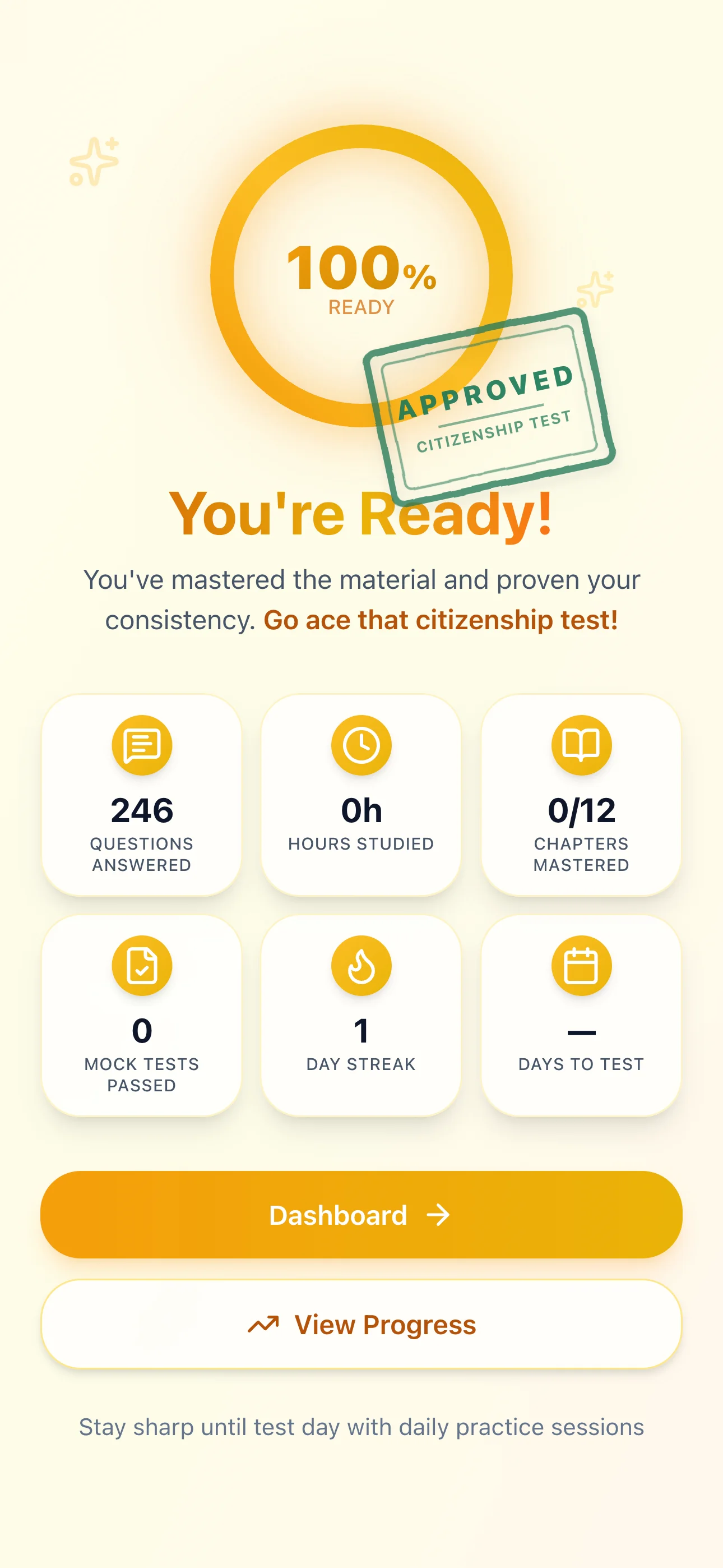
CitizenPrep does exactly this — it tracks every question you answer, identifies the concepts where you struggle most, and keeps surfacing those until you've demonstrated real mastery. Once you've covered everything, it shows a "You Are Ready" signal so you know — without guessing — that you're ready to book the test.
Try CitizenPrep free →
Our daily concept feature sends you one citizenship fact per day with a mini-quiz — a low-effort way to build knowledge over time using spaced repetition.
For a comparison of different study apps, see our guide to the best citizenship test apps.
What Real Test Takers Did: Forum Evidence
We analyzed dozens of threads on Reddit and CanadaVisa forums to find what study approaches people actually used — and what scores they got. Here are the patterns.
The "read and test" combo (most common among high scorers)
One CanadaVisa user who scored 20/20 shared their method: read the Discover Canada guide thoroughly, paying attention to every detail, then take practice tests until you consistently score perfect. They finished the actual test in just 8 minutes.
A Reddit user on r/askTO described a similar approach: read the guide once, do as many practice tests as possible, and focus on the questions you get wrong. They scored 19/20.
The "minimal prep" success stories
On the CanadaVisa forum, one user described studying for just 2 days: "Read the book casually once and then in detail a second time... along with practice questions." They scored 20/20.
Multiple Reddit users report passing after just a few days of focused study — but almost all of them mention using practice tests, not just reading.
The pattern
Across all the success stories, the common elements are:
- Read the Discover Canada guide at least once (most read it twice)
- Take practice tests — lots of them
- Review wrong answers by going back to the guide
- Repeat until consistently scoring 80%+
The people who struggled or failed usually relied on reading alone, used outdated materials, or did not take enough practice tests.
What Does NOT Work
Based on forum reports and learning science, here are the approaches that lead to lower scores or failure:
Just reading the guide once
Reading the Discover Canada guide from cover to cover once — without taking notes, without pausing to quiz yourself, without following up with practice tests — is not enough for most people. You might remember the general themes, but you will miss the specific dates, names, and details that the test asks about.
Cramming the night before
The citizenship test covers a lot of ground: 63 pages of Canadian history, government, geography, rights, and responsibilities. Trying to absorb all of this in one sitting is fighting against how your brain works. Research consistently shows that spaced practice (studying over multiple days) dramatically outperforms massed practice (cramming).
Using outdated materials
The Discover Canada guide gets updated. Governors General change. Premiers change. If you are using practice tests or study materials from 5+ years ago, some answers may be wrong. Always start with the current official guide.
Memorizing without understanding
Some people try to memorize lists of facts without understanding the context. This makes the information harder to remember and harder to apply. For example, instead of memorizing "Confederation was in 1867," understand why it happened — four provinces united to form a new country. Context creates memory hooks.
Relying only on passive methods
Watching YouTube videos, listening to the audio guide, or reading summaries — without ever testing yourself — feels productive but produces weak memories. You need to retrieve information (through practice tests or flashcards) to actually retain it.
The Ideal Study Plan: A Proven Combination
Based on what works in the research and what high scorers on the forums actually did, here is the most effective approach:
Step 1: Read the Discover Canada guide (Days 1-3)
Read it once for a general understanding. Do not try to memorize everything. Just get familiar with the topics and structure. Highlight or note the facts that surprise you or seem hard to remember.
Step 2: Take your first practice test (Day 3 or 4)
Before you feel "ready." The point is not to score well — it is to see which topics you actually absorbed and which ones you need to focus on. Check our practice questions to get started.
Step 3: Study your weak areas (Days 4-7)
Go back to the chapters where you scored lowest. Re-read them carefully. Make flashcards for facts you keep missing. Use the hardest topics guide to make sure you cover the areas most people find difficult.
Step 4: Practice tests and spaced review (Days 7-14)
Take a different practice test every 2-3 days. Review wrong answers each time. By now, your scores should be climbing. Our daily concept feature can supplement this phase with one fact per day.
Step 5: Final mock test (Day before the test)
Take one final full-length practice test under timed conditions. If you score 80% or higher, you are ready. If not, focus on the specific topics you missed and retest.
For more detail on timelines, see our guide on how long to study for the citizenship test.
How to Know When You Are Ready
You are ready to take the test when:
- You consistently score 80%+ on practice tests. The passing score is 75% (15/20), but you want a buffer. Aiming for 80% means you can afford to get a few tricky questions wrong and still pass comfortably.
- You can explain key concepts without looking them up. What is Confederation? What are the three branches of government? What are your responsibilities as a citizen? If you can answer these off the top of your head, you are in good shape.
- You know the commonly tested details. Names of the first Prime Minister, the date of Confederation, the rights in the Charter, the structure of Parliament. These come up frequently.
- You are not guessing on practice tests. There is a difference between recognizing the right answer and actually knowing it. If you are scoring well but feeling uncertain, do another round of review.
For a complete breakdown of what to expect, read our guide on how to pass the Canadian citizenship test.
Quick Reference: Study Methods Compared
| Method | Effectiveness | Best For | Time Investment |
|---|---|---|---|
| Reading Discover Canada | Medium (alone) | Building foundation | 3-5 hours |
| Practice tests | High | Test readiness, finding gaps | 3-6 hours |
| Flashcards / spaced repetition | High | Memorizing facts, dates, names | 2-4 hours |
| Audio / video | Low-Medium | Commuters, auditory learners | 2-3 hours |
| CitizenPrep | High | Targets your weak areas, shows ready signal | 3-6 hours |
| Combination (recommended) | Very High | Everyone | 8-15 hours total |
Frequently Asked Questions
What is the best way to study for the Canadian citizenship test?
The most effective approach, based on both learning science and real test taker experiences, is to read the Discover Canada guide once or twice, then spend the majority of your study time on practice tests and flashcards. Active study methods (quizzing yourself) produce better results than passive reading alone. Most people who scored 19/20 or 20/20 on forums used this combination.
How many practice tests should I take before the citizenship test?
There is no magic number, but aim to take at least 3-5 full practice tests from different sources before your test day. The goal is to consistently score 80% or higher. If you are still scoring below 75% after several attempts, focus on your weak topics before taking more tests. Quality of review matters more than quantity of tests.
Is reading the Discover Canada guide enough to pass?
For most people, reading the guide alone is not enough. The guide covers 63 pages of dense material, and the test asks about specific details — dates, names, government structures — that are easy to forget without active practice. Most successful test takers on forums recommend combining the guide with practice tests. That said, some people with strong prior knowledge of Canada have passed after reading the guide carefully just once.
How long should I study for the citizenship test?
Most people need 4-6 weeks at 15-30 minutes per day, which works out to roughly 8-15 hours of total study time. Some people with strong backgrounds in Canadian history and fluent English/French pass after just 2-3 days of intensive study. The key factor is not how many hours you put in, but whether you use active study methods like practice tests and flashcards.
Can I study for the citizenship test on my phone?
Yes. The Discover Canada guide is available as a PDF you can read on your phone, and the audio version is a free MP3 download. Several citizenship test apps offer practice questions on mobile. Studying in short sessions on your phone — even 10-15 minutes during a commute — adds up over time and actually works well with spaced repetition principles.
What topics should I focus on most?
Government structure, Canadian history (especially Confederation and key dates), and rights and responsibilities are the areas most people find hardest — and they appear frequently on the test. See our full breakdown of the hardest citizenship test topics for specific areas to prioritize.
What score do I need to pass the citizenship test?
You need to answer at least 15 out of 20 questions correctly, which is 75%. The test is multiple choice and true/false, and you have 45 minutes to complete it — though most people finish in under 15 minutes. For a full walkthrough of the test format, see our guide on what to expect on the online citizenship test. For the official rules, see the IRCC citizenship test page.
The method matters more than the hours — and the research on this is clear. Read the guide, test yourself early, and let your weak spots guide your review. CitizenPrep handles the adaptive part for you — focusing every session on the gaps that actually matter. Start free — no credit card required.