
Canadian Government Structure — Complete Guide for the Citizenship Test
Canadian Government Structure: Complete Guide for the Citizenship Test
Government questions are some of the most frequently tested — and most frequently missed — topics on the Canadian citizenship test. In a 2023 Leger survey, only 23% of Canadians born here scored high enough to pass. The government and parliamentary structure questions were among the hardest.
The challenge isn't that the material is complicated. It's that Canadian government has many layers — a constitutional monarchy, a federal system, three branches, three levels — and the test expects you to keep them all straight.
This guide breaks down the entire Canadian government structure as covered in the Discover Canada guide. Every fact here is sourced directly from the official study material. If you're looking for a broader study strategy, start with our citizenship test study plan.
What Are the Three Key Facts About Canada's Government?
The Discover Canada guide opens the government chapter with three defining facts about Canada's system:
- Federal state — Canada has federal, provincial, territorial, and municipal governments
- Parliamentary democracy — Citizens elect representatives who pass laws and hold government accountable
- Constitutional monarchy — Canada's Head of State is a hereditary Sovereign who reigns according to the Constitution
These three concepts — federal state, parliamentary democracy, constitutional monarchy — are the foundation. Every other detail in this chapter builds on them.
The citizenship test frequently asks about these definitions directly. Know what each term means and how they connect.
What Is a Constitutional Monarchy?
Canada is a constitutional monarchy, which means the Head of State is a hereditary Sovereign (King or Queen) who reigns in accordance with the Constitution — the rule of law.
There is a critical distinction that the test will ask you about:
| Role | Title | Current Holder |
|---|---|---|
| Head of State | The Sovereign (Monarch) | King Charles III |
| Head of Government | The Prime Minister | The leader of the party with the most seats |
The Sovereign is represented in Canada by the Governor General, appointed by the Sovereign on the advice of the Prime Minister, usually for five years.
According to Discover Canada, the Sovereign is:
- A symbol of Canadian sovereignty
- A guardian of constitutional freedoms
- A reflection of Canada's history
As Head of the Commonwealth, the Sovereign links Canada to 53 other nations that cooperate for social, economic, and cultural progress.
This is one of the most commonly missed questions on the citizenship test. Many test takers assume the Prime Minister is the Head of State. On the test, the correct answer is always the Monarch.
What Are the Three Branches of Government?
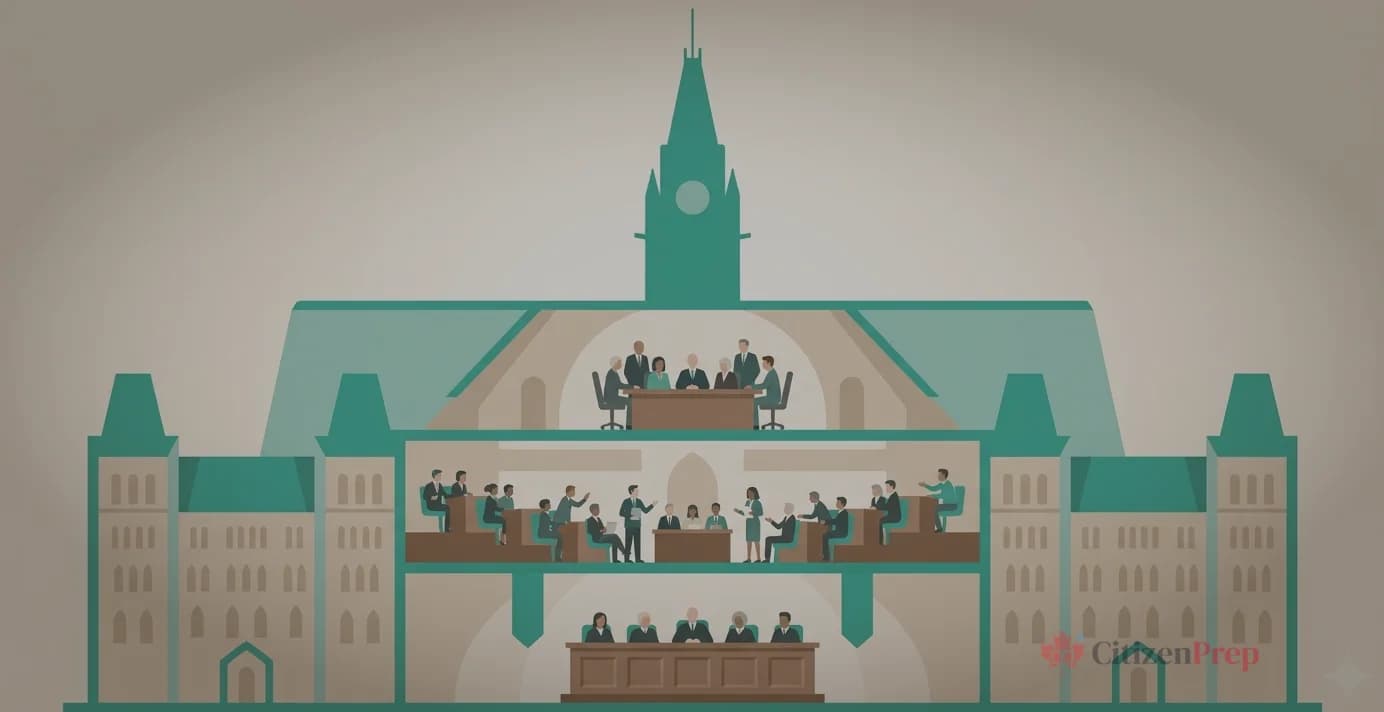
Canada's government is divided into three branches that work together — and sometimes in creative tension — to secure the rights and freedoms of Canadians:
| Branch | What It Includes | Function |
|---|---|---|
| Executive | Prime Minister and Cabinet | Runs the government, proposes laws and budgets |
| Legislative | Sovereign + Senate + House of Commons | Passes and reviews laws |
| Judicial | Supreme Court, Federal Court, Provincial Courts | Interprets and applies laws |
The Supreme Court of Canada is the highest court. It has nine judges appointed by the Governor General.
For test purposes, remember: the Legislative Branch is Parliament, and Parliament has three parts — the Sovereign, the Senate, and the House of Commons.
How Does Parliament Work?
Parliament is Canada's law-making body. It has three parts:
- The Sovereign (represented by the Governor General)
- The Senate
- The House of Commons
Both the Senate and the House of Commons consider and review bills (proposals for new laws). No bill can become law until it has been passed by both chambers and received royal assent, granted by the Governor General on behalf of the Sovereign.
The House of Commons
The House of Commons is the representative chamber. Canada is divided into 308 electoral districts (also called ridings or constituencies), and the citizens in each one elect a Member of Parliament (MP).
Note: Discover Canada states 308 electoral districts. The actual number was increased to 338 in 2015 and 343 after the 2024 redistribution. For the citizenship test, answer 308 — questions are based on Discover Canada.
Key facts about the House of Commons:
- Members are elected by citizens in each riding
- Elections are held traditionally every four years (third Monday in October)
- The Prime Minister can ask the Governor General to call an earlier election
- The candidate who receives the most votes in each riding becomes the MP (first-past-the-post)
- Canadian citizens 18 years or older can run as candidates
The Senate
- 105 members, appointed (not elected)
- Appointed by the Governor General on the advice of the Prime Minister
- Senators serve until age 75
- The Senate reviews and can amend bills passed by the House of Commons
Key Differences at a Glance
| Feature | House of Commons | Senate |
|---|---|---|
| Members | 308 (per Discover Canada) | 105 |
| How selected | Elected by citizens | Appointed by GG on PM's advice |
| Term | Until next election (~4 years) | Until age 75 |
| Role | Represents citizens, introduces most bills | Reviews legislation, represents regions |
What are the three parts of Parliament?
What Does the Prime Minister Do?
The Prime Minister is the Head of Government (not the Head of State). After an election, the leader of the political party with the most seats in the House of Commons is invited by the Governor General to form the government.
The PM's responsibilities include:
- Selecting Cabinet ministers (most from the House of Commons)
- Running the operations and policy of the government
- Advising the Governor General on key appointments
The PM is not directly elected by all Canadians — voters elect their local MP, and the leader of the party with the most seats becomes PM.
Majority vs. Minority Government
| Type | Definition |
|---|---|
| Majority government | The party in power holds at least half of the seats in the House of Commons |
| Minority government | The party in power holds less than half of the seats |
The PM and Cabinet must retain the confidence of the House — the support of the majority of MPs. If defeated on a major vote (like the budget), this usually results in a new election.
What Is the Cabinet?
The Cabinet is the Prime Minister and the Cabinet ministers together. The PM chooses the ministers of the Crown, most from the House of Commons.
Cabinet ministers:
- Are responsible for running federal government departments
- Prepare the budget and propose most new laws
- Must retain the confidence of the House — they answer to elected representatives
- Can be questioned by all members of the House of Commons
The Opposition
The parties not in power are the opposition parties. The opposition party with the most seats is the Official Opposition (also called His Majesty's Loyal Opposition).
According to Discover Canada, the role of opposition parties is to peacefully oppose or try to improve government proposals.
The guide names three major political parties represented in the House of Commons: the Conservative Party, the Liberal Party, and the New Democratic Party.
How Does a Bill Become Law in Canada?
The citizenship test sometimes asks about the legislative process. Discover Canada outlines seven steps:
| Step | Stage | What Happens |
|---|---|---|
| 1 | First Reading | The bill is introduced and printed |
| 2 | Second Reading | Members debate the bill's principle |
| 3 | Committee Stage | Committee members study the bill clause by clause |
| 4 | Report Stage | Members can make amendments |
| 5 | Third Reading | Members debate and vote on the bill |
| 6 | Senate | The bill follows a similar process in the Senate |
| 7 | Royal Assent | Passed by both chambers, the bill receives royal assent from the Governor General |
The key fact for the test: a bill must pass both the House of Commons and the Senate, then receive royal assent to become law.
What Are the Three Levels of Government in Canada?
Canada has three levels of government, each with distinct responsibilities defined by the Constitution Act, 1867 (originally the British North America Act):
Federal Government
Responsible for matters that affect the whole country:
- Defence and foreign policy
- Interprovincial trade and communications
- Currency and navigation
- Criminal law
- Citizenship
Provincial and Territorial Government
Each province has its own elected Legislative Assembly (similar to the House of Commons). Elected members are called:
- MLAs (Members of the Legislative Assembly) — most provinces
- MNAs (Members of the National Assembly) — Quebec
- MPPs (Members of Provincial Parliament) — Ontario
- MHAs (Members of the House of Assembly) — Newfoundland and Labrador
Provincial responsibilities include:
- Education and health
- Natural resources
- Property and civil rights
- Highways
The Premier leads the provincial government (similar to the PM federally). The Lieutenant Governor represents the Sovereign in each province (similar to the Governor General federally). In the three territories, the Commissioner represents the federal government.
Municipal/Local Government
Municipal governments have a council that passes by-laws affecting the local community. The council usually includes a mayor (or reeve) and councillors (or aldermen).
Municipal responsibilities include:
- Urban planning, streets, and roads
- Sanitation, snow removal, firefighting
- Emergency services and public transit
- Recreation facilities
- Some local health and social services
Shared Responsibilities
Two areas are shared between federal and provincial governments:
- Agriculture
- Immigration
Quick-Reference: Responsibilities by Level
| Responsibility | Federal | Provincial | Municipal |
|---|---|---|---|
| Defence / Foreign policy | Yes | ||
| Criminal law | Yes | ||
| Citizenship | Yes | ||
| Currency | Yes | ||
| Education | Yes | ||
| Health care | Yes | ||
| Natural resources | Yes | ||
| Highways | Yes | ||
| Property / civil rights | Yes | ||
| Snow removal | Yes | ||
| Firefighting / EMS | Yes | ||
| Public transit | Yes | ||
| Recycling programs | Yes | ||
| Agriculture | Shared | Shared | |
| Immigration | Shared | Shared |
Quick-Reference: Who Leads Each Level
| Level | Head of Government | Sovereign's Representative | Elected Members |
|---|---|---|---|
| Federal | Prime Minister | Governor General | MPs (House of Commons) |
| Provincial | Premier | Lieutenant Governor | MLAs / MNAs / MPPs / MHAs |
| Territorial | Premier | Commissioner | MLAs |
| Municipal | Mayor (or reeve) | N/A | Councillors (or aldermen) |
What About First Nations Governance?
Discover Canada notes that First Nations have band chiefs and councillors with major responsibilities on reserves, including housing, schools, and other services. There are also provincial, regional, and national Aboriginal organizations that represent First Nations, Metis, and Inuit peoples in their relationships with federal, provincial, and territorial governments.
Study Tips for Government Questions
Government and parliamentary structure is one of the hardest topics on the citizenship test. Here's how to approach it:
-
Learn the structure top-down. Start with the three key facts (federal state, parliamentary democracy, constitutional monarchy), then build out from there.
-
Focus on the distinctions the test loves. Head of State vs. Head of Government. Elected (House of Commons) vs. appointed (Senate). Federal vs. provincial responsibilities.
-
Use the comparison tables. The test frequently asks you to match responsibilities to the correct level of government. The tables above are designed for exactly this.
-
Don't confuse real-world knowledge with test answers. Discover Canada says 308 electoral districts. The real number is higher. For the test, answer 308. See our Discover Canada cheat sheet for more cases like this.
-
Practice daily. Try one concept per day to reinforce government terms without cramming.
For a full chapter-by-chapter approach, see our citizenship test study guide.
Frequently Asked Questions
How many members does the House of Commons have?
According to the Discover Canada guide, the House of Commons has 308 members (one MP per electoral district). The actual number was increased to 338 in 2015 and 343 after the 2024 redistribution. For the citizenship test, use the Discover Canada number: 308.
How many senators are there in Canada?
Canada has 105 senators. They are appointed by the Governor General on the advice of the Prime Minister and serve until age 75.
What is the difference between the Head of State and the Head of Government?
The Head of State is the Sovereign (currently King Charles III), who reigns according to the Constitution. The Head of Government is the Prime Minister, who directs the actual governing of the country. In Canada, these are two separate roles held by two different people.
How does someone become Prime Minister of Canada?
The leader of the political party with the most seats in the House of Commons is invited by the Governor General to form the government and becomes Prime Minister. Canadians do not directly elect the Prime Minister — they elect their local MP.
What are the three branches of government in Canada?
The three branches are: Executive (Prime Minister and Cabinet), Legislative (Sovereign, Senate, and House of Commons), and Judicial (Supreme Court of Canada, Federal Court, and Provincial Courts).
What is the role of the Governor General?
The Governor General represents the Sovereign in Canada. The GG is appointed by the Sovereign on the advice of the Prime Minister, usually for five years. Key duties include granting royal assent to bills and appointing senators on the PM's advice.
What is the difference between federal and provincial government responsibilities?
The federal government handles national matters like defence, criminal law, citizenship, and currency. Provincial governments handle education, health, natural resources, and highways. Agriculture and immigration are shared between both levels.
Government is one of the most-tested topics on the citizenship test — and the most confused. CitizenPrep covers all 850+ concepts from Discover Canada with adaptive practice that focuses on your weak spots. Start free — no credit card required.