
Plan d'étude pour le test de citoyenneté : calendriers de 1 semaine, 2 semaines et 1 mois
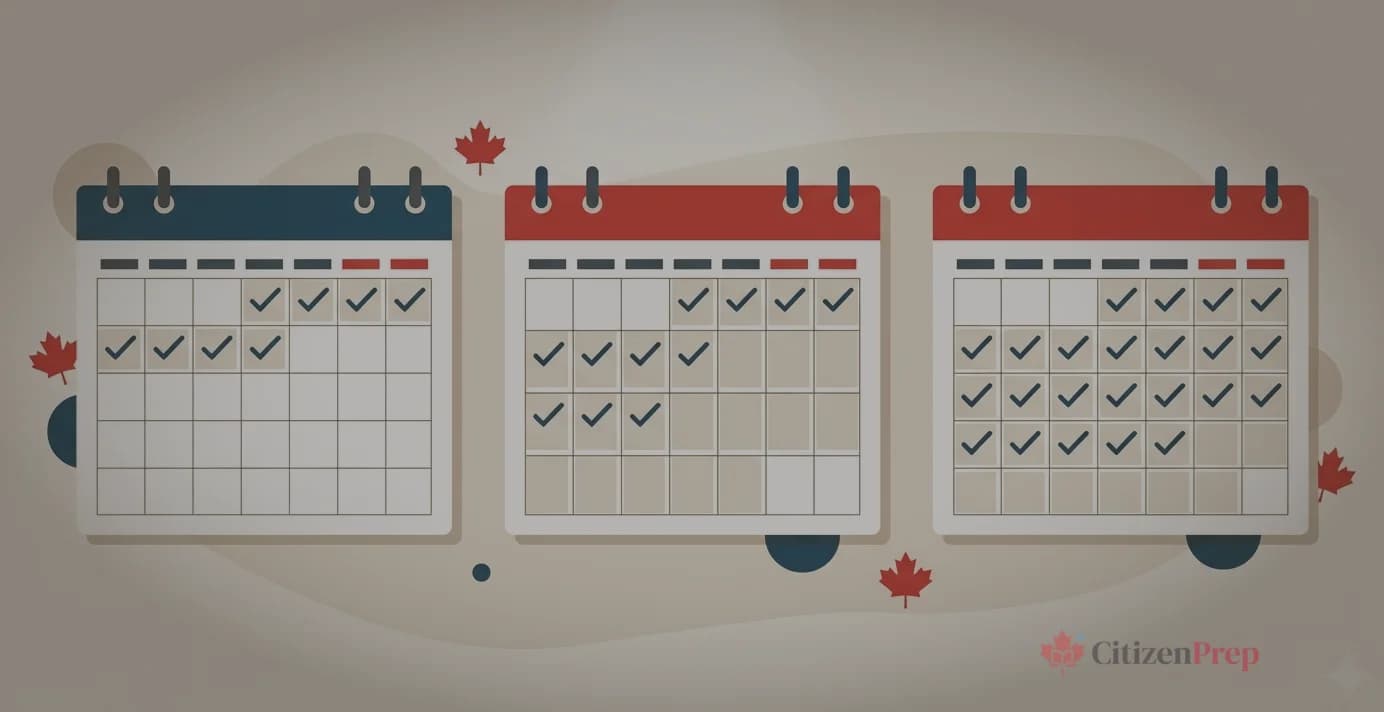
Plan d'étude pour le test de citoyenneté : calendriers de 1 semaine, 2 semaines et 1 mois
Vous avez reçu votre invitation au test. Vous savez que la source est le guide Découvrir le Canada. Mais s'asseoir et lire 64 pages sans plan structuré, c'est le meilleur moyen de perdre du temps sur les mauvais sujets ou de manquer de temps avant d'avoir tout couvert.
Un plan d'étude structuré règle ce problème. Il vous dit exactement quoi étudier chaque jour, combien de temps y consacrer et quand réviser. Que vous ayez un mois, deux semaines ou une seule semaine avant votre test, ces calendriers vous guideront à travers toute la matière importante.
Le test comprend 20 questions, il faut 15 bonnes réponses pour réussir (75 %), et vous disposez de 45 minutes. Le taux de réussite au premier essai est de 86,1 % — avec une bonne préparation, les chances sont largement en votre faveur.
Quel plan d'étude vous convient ?
Avant de choisir un calendrier, soyez honnête sur votre délai et votre niveau.
| Plan | Durée | Idéal pour | Temps quotidien |
|---|---|---|---|
| Plan de 1 mois | 30 jours | Première préparation, apprenants en langue seconde, couverture complète | 20-30 min/jour |
| Plan de 2 semaines | 14 jours | Personnes ayant des connaissances de base sur le Canada, lecteurs confiants | 30-45 min/jour |
| Plan de 1 semaine | 7 jours | Lecteurs rapides, personnes qui repassent le test, bonne connaissance du Canada | 45-60 min/jour |
Pas certain ? Si le français ou l'anglais n'est pas votre langue maternelle, commencez par le plan d'un mois. Vous pourrez toujours accélérer si vous progressez rapidement. Notre guide sur le temps d'étude détaille cette question plus en profondeur.
Les trois plans suivent le même principe : lire le chapitre, puis se tester immédiatement. La recherche montre que le rappel actif est plus efficace que la lecture passive. Chaque journée de ces plans associe lecture et pratique.
Comprendre les chapitres de Découvrir le Canada
Le guide comporte 12 chapitres, mais ils n'ont pas tous le même poids ni la même taille. Pour un aperçu détaillé de chaque chapitre, consultez notre guide d'étude chapitre par chapitre. Voici la répartition :
| Chapitre | Titre | Poids au test | Difficulté |
|---|---|---|---|
| 1 | Le serment de citoyenneté | Faible | Facile |
| 2 | Droits et responsabilités liés à la citoyenneté | Élevé | Moyen |
| 3 | Qui sommes-nous | Moyen | Facile |
| 4 | L'histoire du Canada | Très élevé | Difficile |
| 5 | Le Canada moderne | Moyen | Moyen |
| 6 | Comment les Canadiens se gouvernent | Très élevé | Difficile |
| 7 | Les élections fédérales | Moyen | Moyen |
| 8 | Le système de justice | Moyen | Moyen |
| 9 | Les symboles canadiens | Faible-Moyen | Facile |
| 10 | L'économie canadienne | Faible-Moyen | Facile |
| 11 | Les régions du Canada | Moyen | Moyen |
| 12 | Votre province ou territoire | Faible | Facile |
Les chapitres 4 (Histoire) et 6 (Gouvernement) ont le plus grand poids et sont les sujets les plus difficiles du test. Chaque plan leur accorde du temps supplémentaire.
Le plan de 1 mois (30 jours)
C'est l'approche la plus complète. Vous couvrirez chaque chapitre avec du temps pour la révision, la pratique ciblée et des tests simulés avant le jour J. Recommandé pour la plupart des candidats.
Engagement quotidien : 20-30 minutes.
Semaine 1 : Les chapitres fondamentaux (jours 1-7)
| Jour | Chapitre | Contenu | Pratique |
|---|---|---|---|
| 1 | Ch 1 : Le serment de citoyenneté | Lire le chapitre. Mémoriser à qui vous prêtez serment et ce que vous promettez. Chapitre court. | Pratiquer les concepts du serment sur CitizenPrep |
| 2 | Ch 2 : Droits et responsabilités | Charte des droits et libertés, les quatre libertés fondamentales, droits de mobilité, droits à l'égalité. | Pratiquer Droits et responsabilités — plus de 60 concepts sur CitizenPrep |
| 3 | Ch 2 : Droits et responsabilités (suite) | Responsabilités de la citoyenneté : respect des lois, service de juré, vote. Différence entre droits et responsabilités. | Revoir les concepts du jour 2, puis se tester sur responsabilités vs droits |
| 4 | Ch 3 : Qui sommes-nous | Peuples autochtones, héritage anglais et français, immigration, multiculturalisme, diversité. | Pratiquer les concepts « Qui sommes-nous » sur CitizenPrep |
| 5 | Ch 4 : L'histoire du Canada (partie 1) | Histoire ancienne jusqu'à la Confédération : Premières Nations, explorateurs, Nouvelle-France, Amérique du Nord britannique, 1867. | Pratiquer l'Histoire du Canada — plus de 150 concepts sur CitizenPrep |
| 6 | Ch 4 : L'histoire du Canada (partie 2) | Après la Confédération : expansion vers l'ouest, les deux guerres mondiales, figures clés (sir John A. Macdonald, sir Wilfrid Laurier, etc.). | Continuer la pratique d'histoire, se concentrer sur les dates et les personnages |
| 7 | Ch 4 : L'histoire du Canada (partie 3) + Révision | De l'après-guerre à aujourd'hui. Puis réviser toute la semaine 1 — se tester sur les faits clés des chapitres 1 à 4. | Session de pratique quotidienne sur les sujets de la semaine 1 |
Semaine 2 : Gouvernement et droit (jours 8-14)
| Jour | Chapitre | Contenu | Pratique |
|---|---|---|---|
| 8 | Ch 5 : Le Canada moderne | Programmes sociaux, bilinguisme officiel, arts et culture, politique de multiculturalisme. | Pratiquer les concepts du Canada moderne sur CitizenPrep |
| 9 | Ch 6 : Comment les Canadiens se gouvernent (partie 1) | Monarchie constitutionnelle, trois branches du gouvernement, Parlement (Chambre des communes + Sénat). | Pratiquer le Gouvernement — plus de 100 concepts sur CitizenPrep |
| 10 | Ch 6 : Comment les Canadiens se gouvernent (partie 2) | Responsabilités fédérales vs provinciales, rôle du Monarque, du Gouverneur général, du Premier ministre. | Se concentrer sur chef d'État vs chef du gouvernement — très souvent testé |
| 11 | Ch 7 : Les élections fédérales | Processus de vote, qui peut voter, fonctionnement des élections, circonscriptions électorales. | Pratiquer les concepts des élections fédérales sur CitizenPrep |
| 12 | Ch 8 : Le système de justice | Tribunaux, primauté du droit, police, droits de l'accusé, types de droit. | Pratiquer les concepts du système de justice sur CitizenPrep |
| 13 | Révision : Chapitres 5 à 8 | Revenir sur les sujets de gouvernement ou de droit qui n'étaient pas clairs. Se concentrer sur les sujets les plus difficiles. | Se tester sur la structure gouvernementale et les élections |
| 14 | Révision de mi-parcours | Revoir vos points faibles des semaines 1 et 2. Refaire les questions ratées. | Session complète de révision sur CitizenPrep |
Semaine 3 : Symboles, économie et régions (jours 15-21)
| Jour | Chapitre | Contenu | Pratique |
|---|---|---|---|
| 15 | Ch 9 : Les symboles canadiens | La Couronne, le drapeau national, la feuille d'érable, le castor, l'hymne national, les édifices du Parlement, les armoiries. | Pratiquer les concepts des symboles canadiens sur CitizenPrep |
| 16 | Ch 10 : L'économie canadienne | Ressources naturelles, grandes industries, commerce, économie de services, différences économiques régionales. | Pratiquer les concepts de l'économie sur CitizenPrep |
| 17 | Ch 11 : Les régions du Canada (partie 1) | Provinces atlantiques (T.-N.-L., Î.-P.-É., N.-É., N.-B.) et Canada central (QC, ON) — capitales, faits clés. | Pratiquer les régions — plus de 80 concepts sur CitizenPrep |
| 18 | Ch 11 : Les régions du Canada (partie 2) | Provinces des Prairies (MB, SK, AB), côte Ouest (C.-B.) et territoires du Nord (YT, T.N.-O., NU). | Continuer la pratique des régions, se concentrer sur les capitales et industries |
| 19 | Ch 12 : Votre province ou territoire | Étudier les faits propres à votre province ou territoire de résidence. | Pratiquer les concepts de votre province/territoire sur CitizenPrep |
| 20 | Révision : Chapitres 9 à 12 | Revoir symboles, économie et régions. Se concentrer sur les capitales provinciales et les faits régionaux. | Se tester sur la géographie et les symboles |
| 21 | Révision complète | Revoir l'aide-mémoire Découvrir le Canada — 100 faits essentiels. | Session complète de pratique sur CitizenPrep |
Semaine 4 : Révision et tests simulés (jours 22-30)
| Jour | Chapitre | Contenu | Pratique |
|---|---|---|---|
| 22 | Points faibles | Identifier vos 3 chapitres les plus faibles d'après vos résultats de pratique. Relire ces sections. | Pratique ciblée sur les chapitres faibles sur CitizenPrep |
| 23 | Approfondissement : Histoire | Revenir au chapitre 4. Revoir les dates clés, les personnages et les événements. C'est le plus gros chapitre. | Session de pratique axée sur l'histoire |
| 24 | Approfondissement : Gouvernement | Revenir au chapitre 6. Revoir la structure du gouvernement, les rôles, les pouvoirs fédéraux vs provinciaux. | Session de pratique axée sur le gouvernement |
| 25 | Test simulé 1 | Faire un test complet de 20 questions. Se chronométrer (45 minutes). | Test simulé complet sur CitizenPrep |
| 26 | Révision du test 1 | Revoir chaque question ratée. Retourner au guide pour ces sujets. | Réétudier les sujets manqués |
| 27 | Test simulé 2 | Faire un autre test complet. Objectif : 17/20 ou plus. | Test simulé complet sur CitizenPrep |
| 28 | Révision légère | Parcours rapide de l'aide-mémoire. Se concentrer sur les faits qu'on oublie toujours. | Session de pratique légère |
| 29 | Test simulé 3 (final) | Un dernier test complet. Si vous obtenez 17+ de façon constante, vous êtes prêt. | Dernier test simulé sur CitizenPrep |
| 30 | Repos | Révision légère seulement. Relire le serment de citoyenneté. Bien dormir. Vous êtes prêt. | Optionnel : une courte session de pratique pour la confiance |
Quel chapitre du guide Découvrir le Canada est le plus long et a le plus grand poids au test ?
Le plan de 2 semaines (14 jours)
Ce plan couvre les 12 chapitres mais avance plus vite. Il priorise les chapitres à fort poids et combine les chapitres plus légers en une seule journée.
Engagement quotidien : 30-45 minutes.
| Jour | Quoi étudier | Sujets clés | Pratique |
|---|---|---|---|
| 1 | Ch 1 + Ch 2 : Serment, Droits et responsabilités | Formulation du serment, libertés de la Charte, responsabilités citoyennes, droits vs responsabilités | Pratiquer sur CitizenPrep — plus de 60 concepts Droits et responsabilités |
| 2 | Ch 3 : Qui sommes-nous | Peuples autochtones, héritage français/anglais, multiculturalisme, immigration | Pratiquer les concepts « Qui sommes-nous » sur CitizenPrep |
| 3 | Ch 4 : L'histoire du Canada (partie 1) | Premières Nations, explorateurs, Nouvelle-France, conquête britannique, route vers la Confédération | Pratiquer l'Histoire — plus de 150 concepts sur CitizenPrep |
| 4 | Ch 4 : L'histoire du Canada (partie 2) | Confédération (1867), résistance des Métis, guerres mondiales, figures historiques clés | Continuer la pratique d'histoire |
| 5 | Ch 5 : Le Canada moderne | Changements d'après-guerre, programmes sociaux, bilinguisme officiel, arts et culture | Pratiquer le Canada moderne sur CitizenPrep |
| 6 | Ch 6 : Comment les Canadiens se gouvernent | Trois branches, Parlement, fédéral vs provincial, chef d'État vs chef du gouvernement | Pratiquer le Gouvernement — plus de 100 concepts sur CitizenPrep |
| 7 | Ch 7 + Ch 8 : Élections et Justice | Vote, circonscriptions, tribunaux, primauté du droit, types de droit | Pratiquer Élections et Justice sur CitizenPrep |
| 8 | Révision : Chapitres 1 à 8 | Se concentrer sur l'Histoire et le Gouvernement — les deux chapitres les plus lourds | Session complète de révision sur CitizenPrep |
| 9 | Ch 9 + Ch 10 : Symboles et Économie | Symboles nationaux, drapeau, hymne, armoiries, grandes industries, commerce | Pratiquer Symboles et Économie sur CitizenPrep |
| 10 | Ch 11 : Les régions du Canada | Toutes les provinces et territoires — capitales, industries clés, faits géographiques | Pratiquer les Régions — plus de 80 concepts sur CitizenPrep |
| 11 | Ch 12 + Points faibles | Votre province/territoire, puis revoir vos 2-3 chapitres les plus faibles | Pratique ciblée sur CitizenPrep |
| 12 | Test simulé 1 + Révision | Test complet de 20 questions, puis révision des erreurs | Test simulé sur CitizenPrep |
| 13 | Test simulé 2 + Points faibles | Deuxième test, puis réétudier les points encore faibles | Test simulé sur CitizenPrep |
| 14 | Révision finale + repos | Parcours rapide de l'aide-mémoire, puis repos | Pratique légère pour la confiance |
Le plan de 1 semaine (7 jours)
Sept jours, c'est serré mais faisable — surtout si vous avez des bases sur le Canada ou si vous repassez le test. Ce plan se concentre sur les chapitres à plus fort poids sans rien sauter, mais avance rapidement.
Engagement quotidien : 45-60 minutes.
| Jour | Quoi étudier | Sujets clés | Pratique |
|---|---|---|---|
| 1 | Ch 1 + Ch 2 + Ch 3 : Serment, Droits, Qui sommes-nous | Serment, Charte des droits, quatre libertés, responsabilités, peuples autochtones, multiculturalisme | Pratiquer sur CitizenPrep — commencer par Droits et responsabilités |
| 2 | Ch 4 : L'histoire du Canada (chapitre complet) | Tout le chapitre d'histoire — des Premières Nations à l'ère moderne. Dates clés : 1867, 1885, 1917, 1982. Personnages : Macdonald, Laurier, Borden. | Histoire — plus de 150 concepts sur CitizenPrep |
| 3 | Ch 5 + Ch 6 : Canada moderne et Gouvernement | Programmes sociaux, bilinguisme, trois branches du gouvernement, Parlement, fédéral vs provincial, chef d'État | Gouvernement — plus de 100 concepts sur CitizenPrep |
| 4 | Ch 7 + Ch 8 : Élections et Justice | Processus de vote, circonscriptions, tribunaux, primauté du droit, police, droits juridiques | Pratiquer Élections et Justice sur CitizenPrep |
| 5 | Ch 9 + Ch 10 + Ch 11 + Ch 12 : Symboles, Économie, Régions | Symboles nationaux, grandes industries, toutes les provinces et territoires avec capitales, votre province | Pratiquer Symboles, Économie, Régions sur CitizenPrep |
| 6 | Révision complète + Test simulé | Revoir l'aide-mémoire, puis faire un test complet de 20 questions | Test simulé sur CitizenPrep — viser 17/20+ |
| 7 | Points faibles + Test final | Réétudier tout ce qui a été raté. Faire un dernier test. Se reposer avant le jour J. | Dernier test simulé sur CitizenPrep |
Conseils d'étude applicables à tous les plans
1. Lire le chapitre, puis se tester immédiatement
Ne lisez pas trois chapitres pour ensuite essayer de tout retenir. Lisez un chapitre (ou une section), fermez le guide et demandez-vous : Quels étaient les faits clés ? Quels noms et dates ont été mentionnés ? C'est le rappel actif, et c'est la méthode d'étude la plus efficace selon la recherche en apprentissage.
2. Se concentrer sur ce qu'on rate
Après chaque session de pratique, notez les sujets ou questions qui vous ont posé problème. Retournez à ces sections spécifiques dans le guide Découvrir le Canada. Vos points faibles sont là où se trouvent les points à gagner.
3. Ne pas tout mémoriser — comprendre les schémas
Le test comporte 20 questions tirées d'une banque d'environ 300 à 400 questions (CIC News). Impossible de prédire lesquelles vous aurez. Au lieu de mémoriser des réponses individuelles, comprenez les faits sous-jacents. Si vous savez que la Confédération date de 1867 avec quatre provinces, vous pouvez répondre à toute question à ce sujet, peu importe la formulation.
4. Utiliser des tableaux et des associations pour les faits difficiles à retenir
Les capitales provinciales, les dates historiques et les rôles gouvernementaux sont plus faciles à retenir dans des formats structurés. L'aide-mémoire Découvrir le Canada organise les 100 faits les plus importants en tableaux pour exactement cette raison.
5. Étudier en sessions courtes, pas en marathons
La recherche sur la répétition espacée montre que quatre sessions de 20 minutes sur quatre jours sont plus efficaces qu'une seule session de 80 minutes. Même si vous n'avez qu'une semaine, répartissez votre étude sur les jours plutôt que de tout faire la veille du test.
6. Faire des tests simulés avant le vrai test
Peu importe le plan choisi, faites au moins un test complet avant le jour J. Chronométrez-vous (vous avez 45 minutes pour 20 questions). Si vous obtenez 17/20 ou plus de façon constante, vous êtes prêt.
7. Ne pas oublier votre province ou territoire
Le chapitre 12 est court, mais des questions sur votre province ou territoire de résidence apparaissent au test. Connaissez votre capitale provinciale, votre premier ministre provincial et tout fait notable propre à votre région.
Que faire le jour du test
Le jour de votre test :
- Faire une révision légère — parcourir l'aide-mémoire ou faire une courte session de pratique. Ne pas apprendre de nouvelle matière.
- Vérifier votre équipement — le test se passe en ligne, en auto-administration. Assurez-vous que votre webcam, votre microphone et votre connexion Internet fonctionnent.
- Préparer vos pièces d'identité — vous aurez besoin des documents indiqués dans votre invitation au test.
- Rester calme — vous avez 45 minutes pour 20 questions. C'est plus de 2 minutes par question. Il n'y a pas de pression de temps.
Pour un guide complet sur le déroulement du jour du test et la suite, consultez notre guide sur le test en ligne et notre article sur ce qui se passe après le test.
Foire aux questions
Combien d'heures faut-il étudier pour le test de citoyenneté canadienne ?
La plupart des candidats ont besoin de 8 à 15 heures d'étude au total, réparties sur plusieurs jours ou semaines. Cela varie selon votre maîtrise du français ou de l'anglais, vos connaissances préalables sur le Canada et votre méthode d'étude. Notre guide sur le temps d'étude détaille cette question selon les profils.
Peut-on réussir le test de citoyenneté en 1 semaine d'étude ?
Oui. Beaucoup de personnes réussissent après une semaine d'étude intensive, surtout si elles vivent au Canada depuis plusieurs années et sont à l'aise en français ou en anglais. L'essentiel est de prioriser les chapitres les plus importants (Histoire et Gouvernement) et de faire beaucoup de questions de pratique plutôt que de simplement lire.
Quels chapitres étudier en premier pour le test de citoyenneté ?
Commencez par le chapitre 2 (Droits et responsabilités) et le chapitre 4 (Histoire du Canada) — ce sont les plus testés. Ensuite, couvrez le chapitre 6 (Gouvernement) et le chapitre 7 (Élections). Gardez les chapitres plus légers (Symboles, Économie) pour la fin.
Combien de questions y a-t-il au test de citoyenneté canadienne ?
Le test comporte 20 questions (choix multiples ou vrai/faux). Il faut 15 bonnes réponses (75 %) pour réussir. Vous disposez de 45 minutes et vous avez jusqu'à 3 tentatives dans une fenêtre de 30 jours.
Quelle est la meilleure façon d'étudier pour le test de citoyenneté ?
L'approche la plus efficace combine la lecture du guide Découvrir le Canada avec des tests de pratique actifs. La recherche montre que se tester soi-même est bien plus efficace que relire ou surligner. Suivez l'un des plans d'étude structurés ci-dessus et utilisez un outil comme CitizenPrep pour la pratique quotidienne avec des cartes d'étude adaptatives.
Le guide Découvrir le Canada suffit-il pour réussir ?
Oui — le guide Découvrir le Canada est la seule source officielle du test. Chaque question provient de ce guide. Cependant, combiner le guide avec des questions de pratique et un plan d'étude structuré améliore significativement la rétention et la confiance.
Que se passe-t-il si j'échoue au test de citoyenneté ?
Vous avez jusqu'à 3 tentatives dans votre fenêtre de test de 30 jours. Si vous ne réussissez pas après 3 tentatives, IRCC planifiera généralement une audience avec un agent de citoyenneté. Votre résidence permanente n'est pas affectée.
Prêt à suivre votre plan d'étude avec de la vraie pratique ? CitizenPrep propose plus de 850 concepts d'étude couvrant chaque chapitre de Découvrir le Canada, avec une pratique adaptative qui se concentre sur ce que vous devez réviser le plus. Commencez gratuitement — aucune carte de crédit requise.